Showing posts with label World War II. Show all posts

Sunday, March 4, 2012

Living the Dream(sville)...


While railroads quickly displaced the Canal Era in Ohio as a new century dawned in America, and in the Buckeye state, rail was no less significant than the shipping traffic on the canals and lakes.  One tiny town in eastern Ohio became a significant layover as the nation steamed across the new iron highway and a shining beacon to the spirit of volunteerism in Americans.  Today the Dennison Depot stands as testimony to how a few thousand made the lives of a few million better, if only for a moment in time.
Dennison became a depot along the rail line between Columbus and Pittsburgh out of necessity.  100 miles was all a locomotive in the late 1800s could go without replenishing water.  Exactly that distant between the two major metropolises, Dennison was born of and for the railroad.  It was said that everyone in Dennison either worked for the railroad or was related to someone who did. 
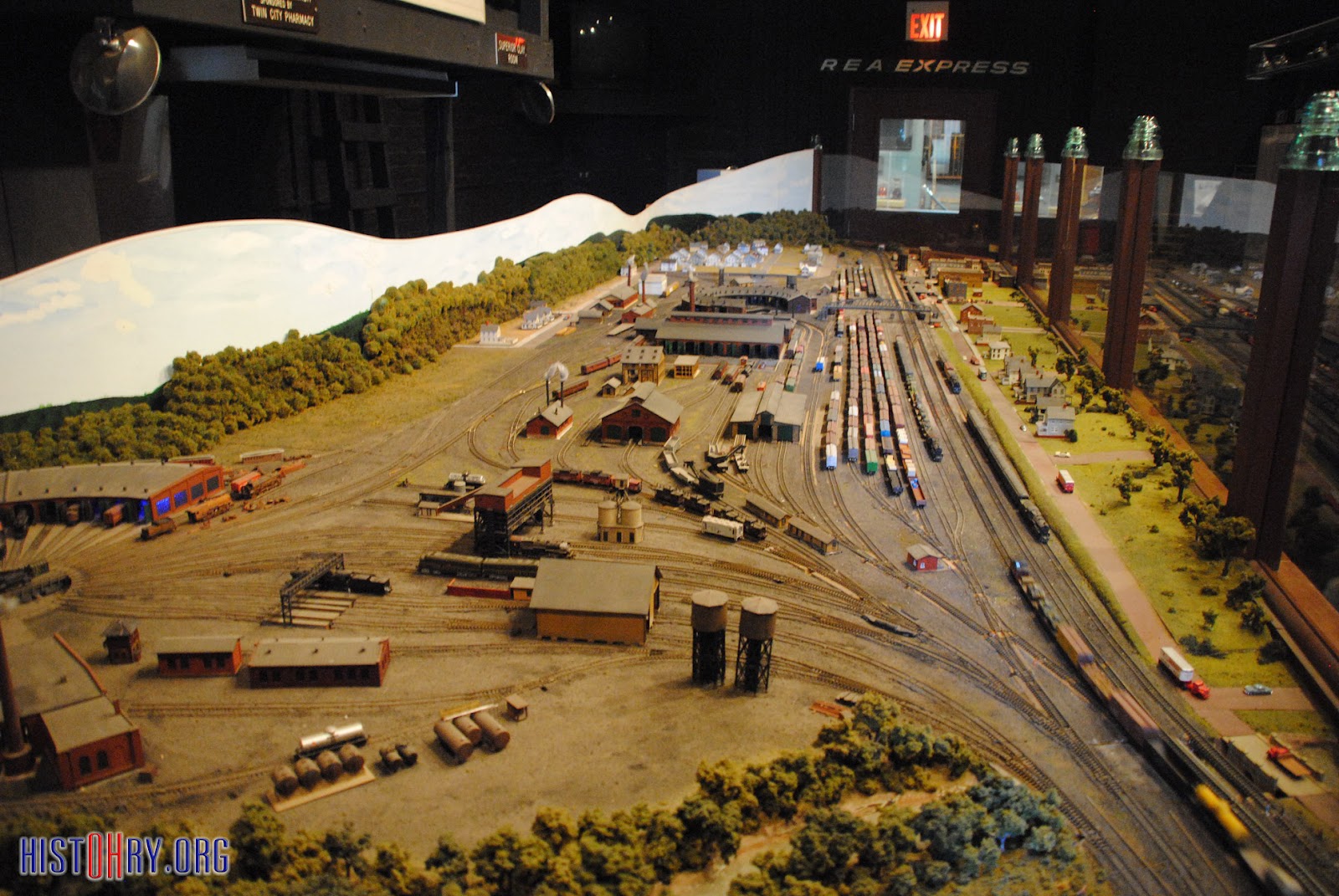

As the 20th Century dawned, it was one of the most complete facilities in the country.  Over 40 acres of various railroad shops saw over 3,000 people employed while over 40 trains a day, split evenly between passenger and freight, passed through town. If you were heading from New York westward towards St. Louis, you would pass through Dennison.  The museum sports a sizable working model train display that replicates the Dennison yard in its heyday.


In the early 1900s, working for the railroad had its slower moments that allowed for a little recreation.  The Pennsylvania Railroad sponsored company baseball teams with one formed locally to Dennison that competed against other similar groups.


While freight moved across the country on countless lines with many different companies, it was a very different cargo that brought fame to Dennison.  During the course of World War II over 1 million soldiers being transported cross country, westward for training or eastward for deployment, had a layover in the tiny town. As the war progressed, some returned in hospital cars that tended to their war wounds.  One of the rail cars in the museum is a restored hospital car.


Locals began operating a canteen specifically for the soldiers and gave them goods free of charge.  Nearly 4,000 volunteers from the surrounding eight counties rotated through the canteen all day, every day.  As word spread, young men eagerly anticipated the stop over in Dennison, so much so that as the war rolled on Dennison began to be called Dreamsville, USA. 

As America moved to the highways and airways in postwar America, Dennison, like many other small rail towns, felt the economic impact.  But like other American small towns with a historic gem, the Village of Dennison was able to purchase the depot in 1984 and through a strong grassroots effort renovated the facility into a museum showpiece. 


There is a considerable display of World War II era items, from the hospital car to a look at the homefront that was Dennison during the war years.  Area residents have donated World War II artifacts that are showcased along a wall of one of the rail cars that even include former ration cards (notated as property of the United States government).


Other restored railcars, some now dating back 100 years, tell the story of rail in Ohio, as America, and how it took a village to raise the hopes of over a million young men at a time of need in the nation’s history.  One car, a restored 1914 passenger car, has a rotating exhibit and at the time of this visit had just ended a Civil War remembrance display.


Another rail car is dedicated to the other industries of the region, including coal and gas. An old uniform of a gas worker and several gas furnishings are on display.  Some of the devices are the first (and larger) versions of today's creature comforts of home.

The museum is very kid-friendly, offering a scavenger hunt for those with an eye for the little things along the way.  There are plenty of hands on activities, from the working telegraph and mock coal chute for the engine boiler to sleeper births and dining cars.  One of the passenger compartments even offers vintage Life Magazines from the 1940s.


The depot itself has several rooms of displays, ranging from the typical behind-glass displays to open-air recreated scenes, such as a luggage carriers placed in about the same place they would have been for decades during the station's active years.  The floor is even the authentic paver bricks. 


The original ticket window displays a large chalkboard of directionally bound trains.  Even numbered running one way, odd the other.  Just off the main ticket window today is a restaurant, called Trax, that operates at regular hours.


Outside the depot to the west are several older rail displays, including a caboose, boxcar, flatbed and very old steam locomotive.  To the east, following the rail cars that serve as the bulk of the museum, there is a massive steam locomotive with 5+ foot wheels and bolts the size of a human fist.  The locomotive, a nearly 300,000 pound monster, sits patiently awaiting the funding to be restored. 


Dennison proper offers a small, but interesting, downtown complete with an actual corner department store. The museum is well-represented on Facebook and is a active advocate for Tuscarawas County historical information and activities.  Just up the road is New Philadelphia and minutes beyond the historic sites of Schoenbrunn and Zoar.
While Dennison may not be the type of "happening" town that brings you out for a day, the museum is well worth a stop to spend an hour or so immersing yourself in the rail culture and how a little town can make a lot of people's life special. The little museum that it could, that it could, that it could has climbed the hill, being honored in July of 2011 and placed on the National Register of Historic Landmarks.  And that's something worth blowing your horn about.

- J.

Saturday, January 3, 2009

Those Daring Young Men in Dayton

Dayton, Ohio (map, government) is home to Wright Patterson Air Force Base and its museum with a spectacular collection of aircraft spanning the entire history of aviation. It is a living memorial to those daring young men and their flying machines. It rivals, or perhaps eclipses, the collection seen in Washington, DC at the Smithsonian Air and Space Museum and Annex.

The complex includes hangars of planes, a memorial park (see right, click to enlarge), iMax theater, cafeteria and gift shop. Housed primarily in three incredibly large hangars, one can freely spend hours wandering the aircraft, artifacts and stories behind the young men, and women, of the air force who have so devotedly served.

"Freely spend" is the operative ph
rase, as it being a government facility there is no charge for parking or admission. In what feels like no time, several hours have passed and there is still more to see. This is not an easy museum to do in one visit unless you can spend most of your day absorbing it all.

Parking is primarily in two long rows and you can easily on a busy day have to walk quite a way to the entrance (an unloading zone is easily accessible). But this allows the visitor to wander through the Memorial Park. Scattered are numerous monuments to various air wings, aircraft and even individual events or pilots. There is tremendous creativity in the variety of monuments erected (see left, click to enlarge).


The hangars are divided into eras: World War I and II, Korea & Vietnam and the Modern Era. There is another hangar off the main base housing Presidential Aircraft and other Wright Brothers historical sites. Each hangar display offers aircraft on the ground, mounted on stands and hanging from the roof. It is easy to be struck at the enormity of the complex (see right, click to enlarge). It is also amazing to see the large variety of planes that flew. For those younger boys (and not-so younger boys), it would be hard to name each plane you encountered.

What is easily lost to history, especially an era where black and white photography was the only archiving footage available, is that many planes sported unusual coloring. Particularly striking to me was the German World War I bi-plane that appears to be supporting breast-cancer awareness well before its time (see left, click to enlarge). Particularly during World War I, many of the planes on display have very colorful paint schemes.

The aircraft are displayed in a manner that puts you right up close to the actual aircraft. These are not mock-ups, but the real aircraft, now retired and preserved. Despite the warnings not to touch, it is difficult when allowed such close proximity to intimidating aircraft, such as the World War II B-24 Liberator bomber (see right, click to enlarge). While the museum is very kid-friendly, there are many points to consider explaining or shooing the young ones past.

Unavoidable is the decorative nose art many of the World War II era planes carry (see B-17 Flying Fortress to below left, click to enlarge). Many are laden with visionary thoughts of ladies in various drawings or statements (or both). It should never be forgotten to history that the flyboys of World War II were as young as 18 and girls are never far from the thoughts of a young man. Even several of the flight jackets carry both whimsical and suggestive artwork. History is what it was and sometimes it may need some explaining to those with different sensitivities. Today reproductions are available for purchase.

Between the World War areas of the first hangar there is a display devoted to Bob Hope (see right, click to enlarge) and his decades of performing for soldiers in combat zones. A native Ohioan, Bob Hope is synonymous with the United Service Organizations (USO). Video and artifact displays do a wonderful job of presenting his patriotic contributions.

While the nose art and jacket art tell one story, there are many displays that touch upon the all too human story of war. Many aircraft on exhibit also have on display related artifacts. Next to a World War II P-38 Lightning, the pilot's flight jacket is rife with shrapnel holes punched through it along with the story of being shot down (see left, click to enlarge).

But one of the most compelling companion aircraft and artifact displays tells the story of the Doolittle Raid on Japan in World War II. The raid was of little productive damage to Tokyo, but served to boost the morale and spirit of America. A retaliatory strike revenging the sneak attack on Pearl Harbor was largely symbolic. But in 1946, a year after the war, the surviving crews from the raid met to celebrate Doolittle's birthday and it has turned into a memorial reunion.

Located
behind the retired B-25 is a series of Goblets that the survivors drink from each year. The photo above right (click to enlarge) shows a blow-up inset of the goblets (above the left engine), the display can be seen between the left engine nacelle and fuselage on a wall at the rear of the plane. When one passes away, his goblet is inverted. As of the past reunion, only 11 surviving crew remain, with Doolittle himself passing away in 1996. Two died in November of 2008, leaving only nine remaining. The final two survivors will open an 1896 bottle of Cognac, donated by Hennessey to commemorate Doolittle's birth year.

Displays are not limited to American craft. Displays of Italian, German, French, English and even Russian combat aircraft can be seen in all of the hangars. One section of the World War II area has several Nazi aircraft, ranging from the first jets and rockets to larger bombers (see right, click to enlarge). In fact it was surprising, but in hindsight shouldn't have been, to hear several different languages being spoken by the visitors on the day I toured the facility.

The Cold War and Modern Era hangars have countless aircraft on display and allow access up to the cockpits, but not inside, some of the less vintage aircraft. One could climb and peer along and then down into an A-10 "Warthog" (see right, click to enlarge). The museum does allow veterans who have flown planes, and who are physically able, to access a plane like he flew.

The retired F-16 that was part of the elite Air Force Thunderbirds demonstration team (see left, click to enlarge) has a mock cockpit that was used for training purposes that one can climb in. Appropriately cautioned, the dimensions are very small in the cockpit and only those nimble and agile enough should take a quick seat behind the controls.

The massive B-52 spans a large portion of the Cold War hangar, giving a symbolic feel to the global implications of nuclear fears that spanned the years following World War II up through the early 1990s. Standing under the open bomb-bay doors, it is unfathomable to see the amount of destruction that could be rained down from these behemoths.


There is still more to uncover at the museum, as if your time allows there are several aircraft displayed outside. Along with the displays a mock-up of what appears a "Mighty 8th" Army Air Force base in England during World War II.

Upon leaving, the F-104 Starfighter mounted at the entrance to the grounds points skyward, beckoning to those who daydream, who dare to dream of the impossible and for those who dared to do and have already been to the wild blue yonder and beyond.

- J.