Showing posts with label Underground Railroad. Show all posts

Sunday, March 4, 2012

Living the Dream(sville)...


While railroads quickly displaced the Canal Era in Ohio as a new century dawned in America, and in the Buckeye state, rail was no less significant than the shipping traffic on the canals and lakes.  One tiny town in eastern Ohio became a significant layover as the nation steamed across the new iron highway and a shining beacon to the spirit of volunteerism in Americans.  Today the Dennison Depot stands as testimony to how a few thousand made the lives of a few million better, if only for a moment in time.
Dennison became a depot along the rail line between Columbus and Pittsburgh out of necessity.  100 miles was all a locomotive in the late 1800s could go without replenishing water.  Exactly that distant between the two major metropolises, Dennison was born of and for the railroad.  It was said that everyone in Dennison either worked for the railroad or was related to someone who did. 
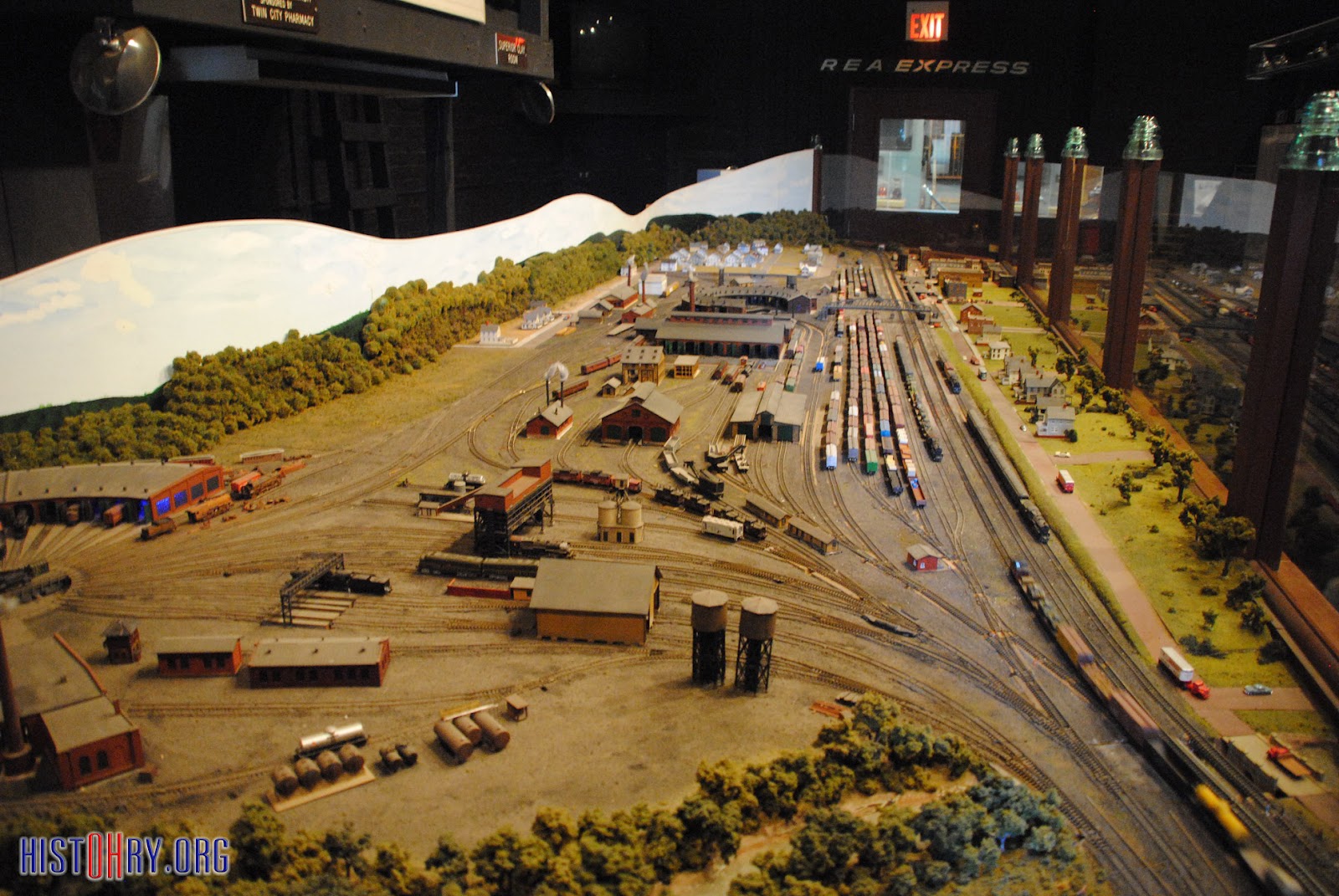

As the 20th Century dawned, it was one of the most complete facilities in the country.  Over 40 acres of various railroad shops saw over 3,000 people employed while over 40 trains a day, split evenly between passenger and freight, passed through town. If you were heading from New York westward towards St. Louis, you would pass through Dennison.  The museum sports a sizable working model train display that replicates the Dennison yard in its heyday.


In the early 1900s, working for the railroad had its slower moments that allowed for a little recreation.  The Pennsylvania Railroad sponsored company baseball teams with one formed locally to Dennison that competed against other similar groups.


While freight moved across the country on countless lines with many different companies, it was a very different cargo that brought fame to Dennison.  During the course of World War II over 1 million soldiers being transported cross country, westward for training or eastward for deployment, had a layover in the tiny town. As the war progressed, some returned in hospital cars that tended to their war wounds.  One of the rail cars in the museum is a restored hospital car.


Locals began operating a canteen specifically for the soldiers and gave them goods free of charge.  Nearly 4,000 volunteers from the surrounding eight counties rotated through the canteen all day, every day.  As word spread, young men eagerly anticipated the stop over in Dennison, so much so that as the war rolled on Dennison began to be called Dreamsville, USA. 

As America moved to the highways and airways in postwar America, Dennison, like many other small rail towns, felt the economic impact.  But like other American small towns with a historic gem, the Village of Dennison was able to purchase the depot in 1984 and through a strong grassroots effort renovated the facility into a museum showpiece. 


There is a considerable display of World War II era items, from the hospital car to a look at the homefront that was Dennison during the war years.  Area residents have donated World War II artifacts that are showcased along a wall of one of the rail cars that even include former ration cards (notated as property of the United States government).


Other restored railcars, some now dating back 100 years, tell the story of rail in Ohio, as America, and how it took a village to raise the hopes of over a million young men at a time of need in the nation’s history.  One car, a restored 1914 passenger car, has a rotating exhibit and at the time of this visit had just ended a Civil War remembrance display.


Another rail car is dedicated to the other industries of the region, including coal and gas. An old uniform of a gas worker and several gas furnishings are on display.  Some of the devices are the first (and larger) versions of today's creature comforts of home.

The museum is very kid-friendly, offering a scavenger hunt for those with an eye for the little things along the way.  There are plenty of hands on activities, from the working telegraph and mock coal chute for the engine boiler to sleeper births and dining cars.  One of the passenger compartments even offers vintage Life Magazines from the 1940s.


The depot itself has several rooms of displays, ranging from the typical behind-glass displays to open-air recreated scenes, such as a luggage carriers placed in about the same place they would have been for decades during the station's active years.  The floor is even the authentic paver bricks. 


The original ticket window displays a large chalkboard of directionally bound trains.  Even numbered running one way, odd the other.  Just off the main ticket window today is a restaurant, called Trax, that operates at regular hours.


Outside the depot to the west are several older rail displays, including a caboose, boxcar, flatbed and very old steam locomotive.  To the east, following the rail cars that serve as the bulk of the museum, there is a massive steam locomotive with 5+ foot wheels and bolts the size of a human fist.  The locomotive, a nearly 300,000 pound monster, sits patiently awaiting the funding to be restored. 


Dennison proper offers a small, but interesting, downtown complete with an actual corner department store. The museum is well-represented on Facebook and is a active advocate for Tuscarawas County historical information and activities.  Just up the road is New Philadelphia and minutes beyond the historic sites of Schoenbrunn and Zoar.
While Dennison may not be the type of "happening" town that brings you out for a day, the museum is well worth a stop to spend an hour or so immersing yourself in the rail culture and how a little town can make a lot of people's life special. The little museum that it could, that it could, that it could has climbed the hill, being honored in July of 2011 and placed on the National Register of Historic Landmarks.  And that's something worth blowing your horn about.

- J.

Tuesday, July 7, 2009

Bridging a great divide

Today there are many bridges spanning the Ohio River between Ohio and her bordering neighbors. But perhaps the most spectacular of these bridges is one of the oldest, dating to the 1860s, crossing the Ohio at Cincinnati (see left, click to enlarge). Its designer is an American icon who became famous for his creation after this magnificent span between Covington and Cincinnati. John Roebling (bio, bridge wiki) earned his place in history for designing a landmark bridge, the iconic Brooklyn Bridge (bridge history with photos), over the East River in New York City.

The engineering marvel, now-named John A. Roebling Bridge (click for bridge specs), took decades to complete, from concept to design to construction. There was only one bridge crossing the Ohio prior to the "Suspension Bridge" (as
Cincy locals called it then), it was at Wheeling, WV and was designed by bridge-design rival Charles Ellet. Roebling and Ellet had competing designs for the Wheeling project, but Roebling won out in Cincinnati.

One of the chief factors in the snail's pace for the construction of the bridge was economic competition. Ferry boat owners feared loss in revenue from a bridge undercutting their business.
Until the 1960s, there was a toll to cross the bridge. Originally in the 1860s, a horse and buggy would be charged 15 cents. By 1960 though a pedestrian crossing the bridge saw a drop in the surcharge down to 1-cent. According to an historic edition of the Cincinnati Post, a grand total of $13.46 was collected for pedestrian traffic on a September day in 1959.

Political fears also carried weight in the construction delay, as the slave-holding Kentuckians feared a land-bridge to the free-soil Ohio might embolden escape attempts. The historical impact of slavery is still felt in modern time with the Roebling Bridge. The National Underground Railroad Freedom Center, which opened in 2004, poignantly and symbolically was built near the base of the bridge in downtown Cincinnati. Tour guides often begin on the second or third floor of the museum, which offers panoramic and stunning views of the bridge and river, with tales of the bridge and slavery.

Unfortunately some of these guides share mythology of the bridge that isn't true. One guide shared that Ellet had originally been chosen to design the bridge, but was jettisoned after his bridge at Wheeling collapsed. While the Wheeling bridge did collapse during construction from a windstorm, no evidence exists that Ellet was originally chosen to design the span at Cincinnati. Additionally, the guide said the bridge was finished prior to the end of the Civil War, but they refused to open the bridge to traffic until after the war for fear of a mad rush of slaves bolting to freedom. Also false, the bridge's wires weren't even laid until the war had ended. Indeed, the war slowed down the construction efforts.

Regardless of the mythology, the bridge is a testament to the brilliant engineering minds of the time. While the decking was made cheaply, primary due to lack of materials in a war-torn economy, and rebuilt at the dawn of the 20th Century, the stone pillars were constructed to carry weights beyond anything imagineable in the day (see right, click to enlarge). The bridge has withstood many floods, small and large, and remained the only bridge spanning the Ohio River to remain open during the great 1937 flood (photo link). Even recent flooding in the late 1990s (photo link) never crested nor damaged the bridge.

But with progress poverty cannot be escaped. Hidden to the rush of cars speeding along the bridge is an encampment along the Ohio side of the river that can only be seen walking the bridge. About a dozen little makeshift tents, of cardboard, wood or Pick-up truck tarps, can be seen in a little homeless camp (see left, click to enlarge). Invisible to both the occupants of hi-rise office towers and the sight-seeing public on riverboat cruises, life goes on for those who have no place to call their own. An attempt by police to sweep the riverfront in the name of public safety was recently thwarted as an attack against homeless.

Today one can walk the bridge between Covington and Cincinnati, crossing between the two business districts in less time than watching a rerun of an episode of WKRP in Cincinnati (view pilot episode), which incidently did show a glimpse of the bridge in its opening credits. There is ample space at each of the two massive stone pillars to gawk (see left, click to enlarge) at the ability to build such a marvel at a time when steam powered machines were in their formative years.

Today both Covington and Cincinnati's skylines continue to grow outward and upward. New professional sports venues skirt the river and more new construction is evident near the bridge base in Cincinnati. I'm sure Roebling would not be surprised to see his structure still standing and that Cincinnati would be a major city in America (at the time it was being built it was among the nation's top 10 in population). But he might be pleasantly surprised at the other architectural structures around the Queen City and across his bridge into Kentucky. But will they still impress 145 years in the future?

- J.

Wednesday, July 9, 2008

Ripley, Believe it or not!

Ripley, Ohio is not just another river town nestled along the winding Ohio River. Reverend John Rankin made his home (National Park website, Ohio Historical website) high atop the hill overlooking the river and Kentucky during the 1850s and it was his house that served as a beacon and a hideout for fugitive slaves escaping that "peculiar institution" in Kentucky and points south. With or without the history, the panoramic view atop the hill is stunning (panoramic picture below, click to enlarge).

But then, imagine a fugitive slave hiding precariously in the wood line across the river, waiting for the time, the opportunity to cross a tricky river and to climb the hill to the Reverend's home, hoping for safe hiding and passage to the next stop along the Underground Railroad. Perhaps stopping at John Parker's house, a free black, who helped countless fugitives pass through the region.

It is said the Reverend Rankin had the hill cleared of trees so that he could see his enemies coming well before they reached him. Today there are stone and wood stairs and those who are stout enough can march up the steps from the base of the "hill." (see left, click to enlarge)


The town of Ripley (map, historical website) is snuggled against the river and while atop the hill the modern economy of the river was at hand as a tow-barge tugged up river with a load of coal (see right, click to enlarge), oblivious that a gaggle of history teachers perched atop the crest having just been immersed in the world of slavery at the National Underground Railroad Freedom Center just an hour's drive or so along the river back west in Cincinnati.

The charter bus I rode to the top of the hill to the Rankin House had difficulty making two turns and had to navigate low-hanging branches. The hill would be impossible to drive up in wintry weather.

The house is quite small and the outlaying buildings no longer exist, including the barn used to hide many runaways over night. Save for a story or three from the ranger stationed at the house, there is not much to learn as you poke around the house and grounds (see below and right, click to enlarge).


The Reverend and his sons were very active in moving runaways in and out of town. To walk inside the house defies the logic of their success, but, unlike many other Underground Railroad stations, their efforts were well documented.


An incredible chapter of our history happened here and standing alone atop the hill looking at the lay of the land to the south and then again to the north, it is daunting to think of escaping one hell and navigating another in hopes of a better life free from bondage.


And yes, this happened in the town of Ripley, believe it... or not. (view from the Rankin House towards Kentucky with Reverend Rankin quote below, click to enlarge)

- J.