Showing posts with label Piatt Castles. Show all posts

Sunday, January 8, 2012

Central Ohio's Cave of Wonders

Historic signage near the entrance
In 1897 a teenage farm hand working the land came across a large sink-hole and curiosity has led to a century of Eco-Tourism in the countryside about an hour west of Columbus.  Robert Noffsinger poked around that sinkhole and found a series of caves below and told the farm's owner, William Reams, who immediately saw an economic opportunity.


Over the intervening century-plus, countless visitors have descended and wandered the estimated 2 miles of passageways. A visit is always cool -- in a multitude of ways -- as the year-round temperature is 54 degrees with over 90% humidity.  The air is cleaner than that above the ground, as the water in and around the caves serves to filter it.  While a trip to the caves is possible regardless of the surface weather, keep in mind that accessing the site through the rolling hills and 2-lane roads may be tricky in icy and snowy weather.

There are two tours of the caves, a regular tour and a historic tour, led by a guide in front and in behind.  Part of this dual touring is to keep groups together while another to keep visitors from plundering the cave as the first tourists did in the early 1900's.  First visitors would take home their own stalactite from the cave, as the tour was a simple light and rope and wave to where the entrance was without the assistance of any guides.


The stalactites and stalagmites in the cave of our two types, calcite and iron oxide (yes, rust).  There a places where both exist together and combinations of the two are seen.  The tour is well lit and photography is encouraged.  But watch your step, as puddles off the main pathway make trying to get the perfectly framed shot challenging.

One room, a half-acre in size, offers a panoramic view of formations that is simply stunning.  The alleged largest stalactite in Ohio resides here as well, and is an estimated 400 pounds.  These formations take 500 to 1,000 years to form and, understandably, a strict no-touching policy is in place as even a single finger touch can cause irreparable damage to nature's slow-drip action.

The toughest part of the 45-minute, mile-long tour is the ascent at the conclusion of the experience.  A 60-step concrete stair way leads you back to the surface, and its current weather conditions.  On a hot day the surface conditions strike you quickly.

There are ample facilities at the caverns, as a welcome center has a sizable gift shop and for the warmer months sells bags of dirt with rocks inside that allow for some panning in the outside miniature mill run.

While at first blush it may seem that a visit to the Caverns is all there is to do in the area, driving towards West Liberty reveals more history to discover.  Along, and just off, Ohio Route 287 is a pair of "castles" built by the Piatt Family in the 1860s.  Both striking structures are available for tours and make for a great half-day in Logan County.

The history of Ohio may have been written by humans, but sometimes those humans took advantage of the natural resources around them.  And Ohio has its share of geologic delights that have shaped the history of Buckeye's.

- J.


View Larger Map

Wednesday, August 3, 2011

Castles among the Corn

The front of Mac-o-Chee Castle
Among the sprawling fields of soybeans, among what was corn and wheat, stand a pair of castles that conspicuously stick out as you travel State Route 287 through Union County just northwest of Columbus.  What was once the lands of the Shawnee Indians, a pair of brothers built on a grand scale just a mile apart from each other in the post Civil War years in Ohio.  The Piatt Castles, called Mac-o-Chee and Mac-a-Cheek Castles, are off the beaten path but an interesting bit of Ohio History and why the state has and still is a destination location.

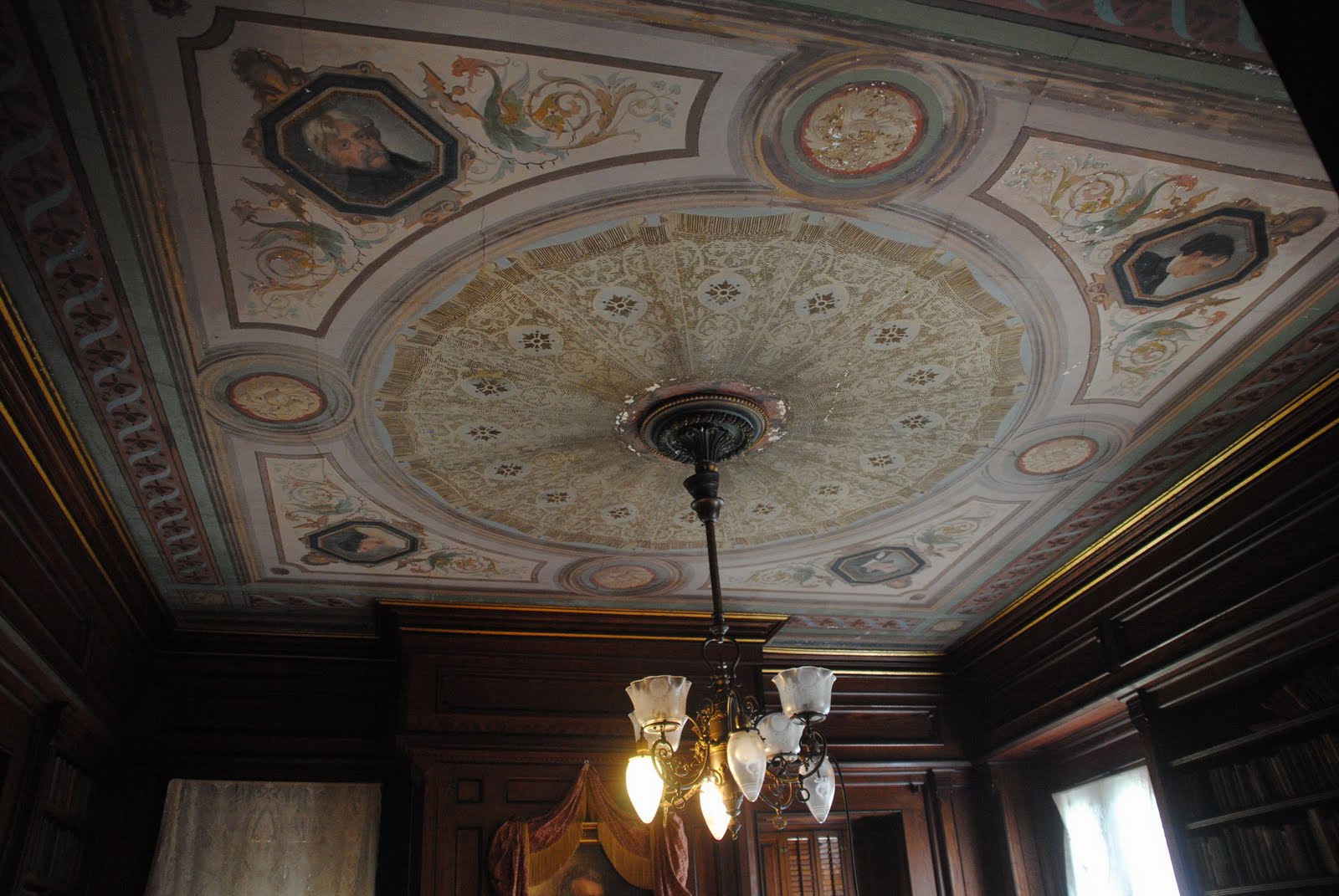
Library of Mac-o-Chee
The Piatt family was involved in early Ohio politics and trading along the Ohio River.  Benjamin Piatt served as a judge in Cincinnati but later moved the family to Logan County where Donn Piatt was raised.  Donn was educated in Cincinnati and moved on to Washington, DC, where he became heavily involved in political causes as a lawyer and newspaper columnist.  An ardent abolitionist, Piatt served in the Civil War as chief off staff to General Schenck in Maryland.  At a moment when Schenk was temporarily away from his post, Piatt is said to have issued an order to enlist only negro slaves in Maryland into the army which would have served to emancipate all of them.  Lincoln is said to have berated Piatt and forced his resignation from the army.  In the years following the Civil War he was quite an inflammatory character towards Presidents Grant and Hayes.


Piatt had the castle Mac-o-Chee built with state of the art technology of the time. Screened windows were patented in the early 1880s and Mac-o-Chee not only uses window screens but unique half-round transom screens above the doorways.  Indoor plumbing was not common at the time, but the home has unique first flushing commodes.

The home fell out of the Piatt family in the 1900's and was used,  unbelievably, as a barn for a local farmer who purchased the property for the land and not the house.  The fanstastic wooden floors have been carefully refurbished but still bear a place where the tractor stored in the "barn" irreparably stained the floor.

As eccentric as the home appears from the road, it was fitting that the home was saved by another eccentric individual.  An unwed daughter of Asa Griggs Candler, the founder of Coca Cola, was traveling through Union County in the 1950s and stopped at the castle and ended up purchasing the house.  One room today bears some of the furniture that she purchased to stock the home, as a castle home should have furniture you would find in a castle.

Mac-o-Chee today shows the wear and tear of a 100+ year old home.  The original paints on the walls and ceilings are fading and chipping.  While a historic home, funding doesn't appear available to speedily restore the home to its one-time splendor.  The tour of the home is mostly self-guided after a staff member gives a basic history and context introduction for the visit.

Abraham Piatt's Mac-a-Cheek
No more than two minutes down the road is the sister castle, Mac-a-Cheek.  Both castle names are derived from the Shawnee language that means "smiling valley."  Donn's brother Abraham built Mac-a-Cheek a bit farther from the road, but this did not stop visitors in the early 1900's from wandering the grounds and then asking to tour the castle.  Abraham thought that if he began charging for tours, which at the time consisted only of the front room of the house, that it would deter tourists.  The opposite occurred.

While the home incredibly stayed in the family for 6 generations, tours continued and it is believed to be the oldest home in Ohio with continuous running tours.  As time marched on, the family receded to other areas of the house and opened up more of the house for tours.  The most impressive room in the house is the grand parlor, which is the size of two or three regular sized rooms and like the sister castle Mac-o-Chee also has painted ceilings and intricate wood working on the floors and walls.
Today one or both homes can be toured.  Mac-a-Cheek in 2011 has a set up an impressive display of Civil War artifacts on the second floor of the home as a commemoration of the 150th anniversary of the Civil War.  A local resident created a diorama of a Virginia battle where an ancestor perished.  The amount of Civil War relics rivals or surpasses that of many larger museums while being restricted to two adjoining rooms. 
Mac-a-Cheek doesn't have tour access to the third floor or towers, while Mac-o-Chee does.  There are allegedly stories of ghosts at Mac-o-Chee.  There are also You Tube videos of the houses in modern times and a 1950s home movie that shows Mac-o-Chee.

Two castles amidst what used to be field of corn, still standing today as a symbol that Ohio once was home to those with powerful national ambitions but wanting to call home a place in the heartland.

J.


View Larger Map