Showing posts with label Civil War. Show all posts

Sunday, May 13, 2012

How to win without winning: Rutherford B. Hayes

In 2000 the nation saw an unusual occurrence in presidential politics.  At the end of election night the nation did not know who the next president would be as the race came down to who won Florida and would take the majority of Electoral College votes.  Ohio has been here before, with our own Rutherford B. Hayes, who in 1876 did not win on election night either.  Like modern times, Florida in 1876 was part of the undecided vote.
    Hayes came up a quarter of a million votes less than New York’s Samuel Tilden but through political wrangling was given the nod in Electoral votes, becoming the third of eight from the Buckeyevstate to occupy the White House.  Hayes directly followed Ulysses S. Grant and handed the reigns over to James A Garfield, whose brief tenure thanks to an assassin’s bullet ended a streak of 13 straight years of an Ohioan president.

Rutherford B. Hayes gave up a budding law practice in Delaware, Ohio to offer his services to the nation during the Civil War.  Appointed as Major of the 23rd Ohio Volunteer Infantry, Hayes served with distinction and rose to the rank of Major General.  Elected to Congress in 1864, Hayes did not take his seat in Washington until after the war ended.  He went on to become a two-term governor for the state.
    
Hayes moved to Spiegel Grove, the name of the 25-acre estate in Fremont, during 1873 in the midst of his second term as Governor. Upon returning he added a 12,000-book library and a 360-degree wrap around view from a rooftop lantern four stories above the main floor. 

The museum boasts acollection of over 19,000 artifacts and 30,000 images with nearly 2,000 on display within the 52,000 square-foot complex.

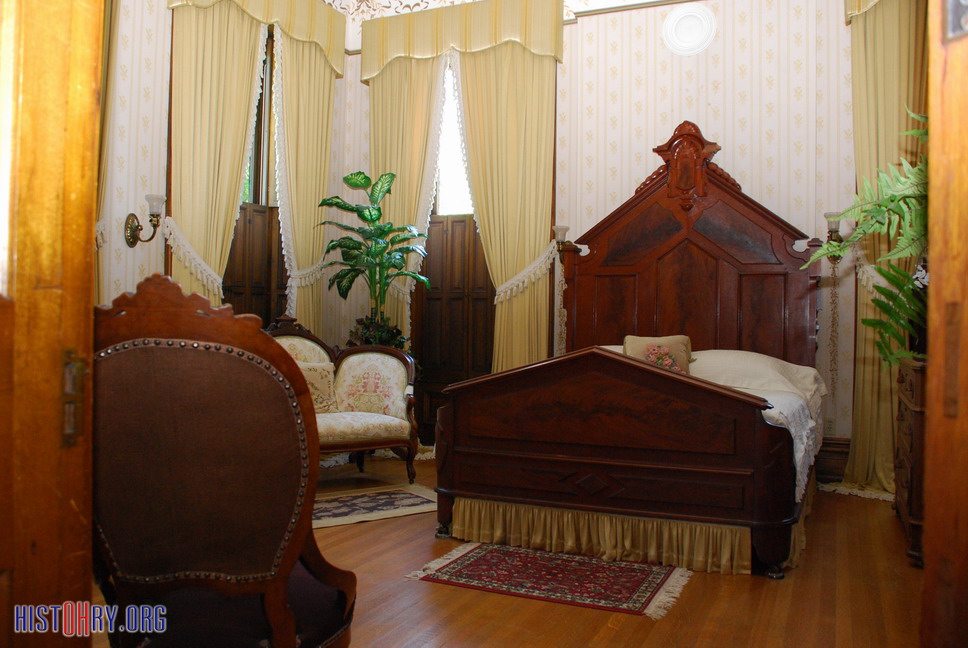
Adjacent to the property is the Dillon House, a Victorian era home that today is part of the Rutherford B. Hayes Presidential Center. 
      
As the Hayes home, the Dillon House can be toured and offers a pristine glimpse into the splendor of the Victorian Era right down to the hinges on the doors. 
      

Charles Dillon gained his wealth in Fremont operating a drug store and chose to display his wealth by moving directly across the street from the former President. Dillon’s wife was daughter of Rutherford’s first law partner, Ralph Buckland.  Buckland also served in the war with distinction and was elected to Congress and also became the Mayor of Fremont.
    
In the 40-year period between 1869 and 1909 five presidents were either born or called Ohio home.  Ohio was the political hub of the nation as the Victorian Age dawned into the 20th Century.  Some criticize Ohio’s claim to eight presidents, as William Henry Harrison was neither born here nor technically resided in the state.  His grandson Benjamin and Ulysses S. Grant did not spend particularly much time Ohio despite being born here.  But similar doubt can be cast on Virginia’s similar claim to eight presidents. 
      
Following Hayes to the White House from Ohio would be Garfield (1881), Harrison (1889), McKinley (1897), Taft (1909) and Harding (1921). Where Virginia was the political powerhouse of the Revolutionary Era, Ohio was as the Victorian Era transitioned toward a world erupting in turmoil.

Spiegel Grove, The Rutherford B.Hayes Presidential Center and the Dillon House are located at the corner of Buckland and Hayes Avenues, south of  U.S. Rt. 20  in Fremont, Ohio.

-J.

Sunday, February 19, 2012

A Corner of the Square for Public Pride

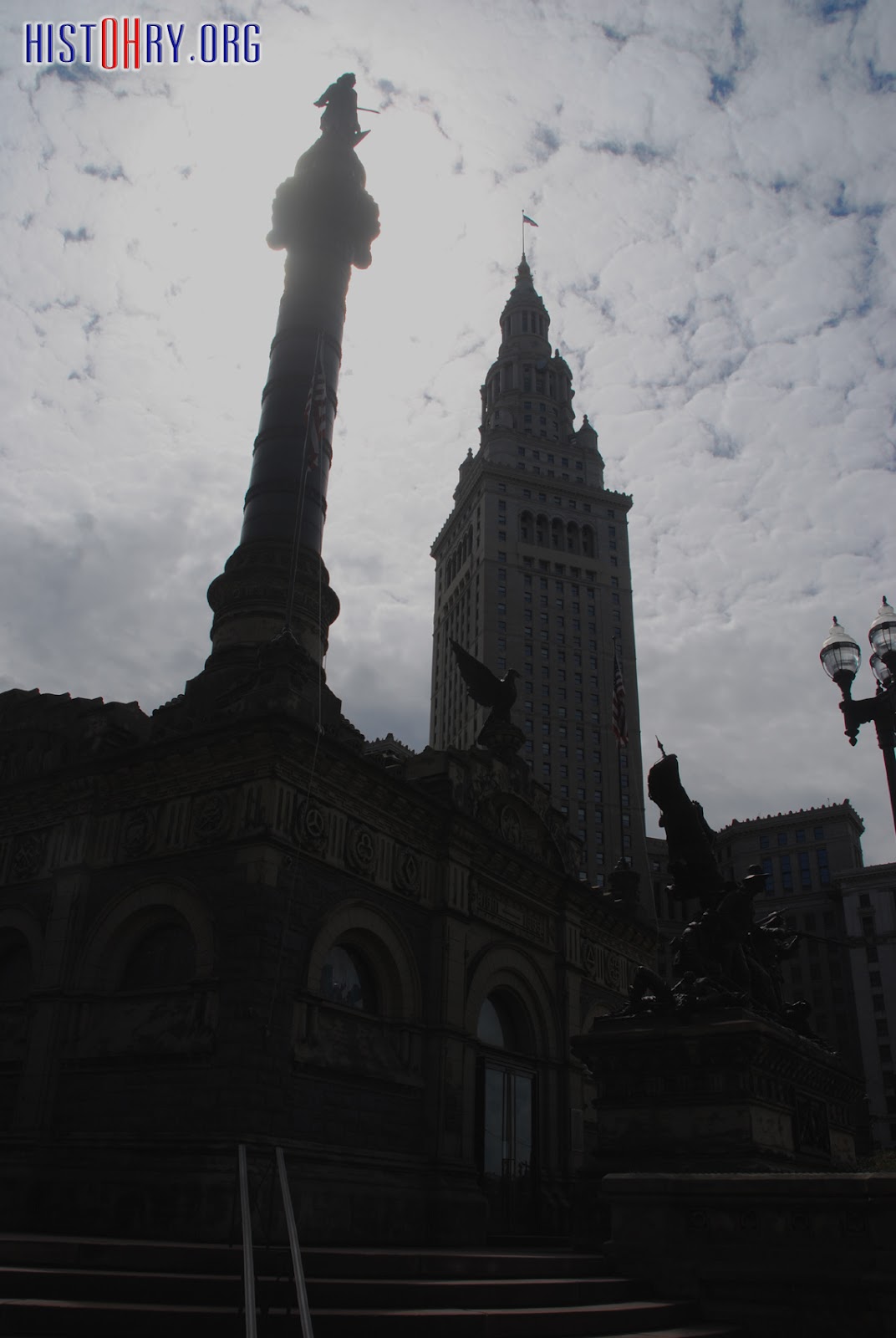
Often overlooked on Downtown Cleveland's Public Square is a small little memorial at the base of a large monument dedicated to those from the city who fought in the Civil War.  The Soldier's and Sailor's Monument occupies one of the four plotted greenspaces on the square, but few wander into the base to view the full memorial.

The 9.5 acres that encompass Public Square was laid out in the late 1850's.  As the Civil War broke out, city planners had dedicated a small monument to Oliver Hazard Perry, hero of the Battle of Lake Erie in the War of 1812.  Perry's Monument has been well-traveled, having been moved on the square, then later to two other locations before being re-cast in bronze and placed near the Cuyahoga County Courthouse.

Public Square in the early 1900s

Perry's Monument was moved in the 1870s to make way for a grand Civil War memorial on one of the four quadrants.  The other sections of the square included a statue to founder Moses Cleaveland and Tom L. Johnson, a former Congressman and Cleveland Mayor.  Electric street lighting was debuted on Cleveland's Public Square in 1879.  By the end of the first World War in 1917, Public Square had seen its heyday.

As the City's Skyline grew throughout the 1900s, Public Square became more of a transportation center than public park.  The Terminal Tower, built in 1928, stood atop the rail connections for the city and anchored the square.  For 25 years it stood as the tallest building outside of New York City. It remained Cleveland's tallest structure, despite a competing high-rise built in the 1980s as the BP (Oil) Building (which in 2012 is the Huntington Building). 

As Ohio's economy stumbled along through the second half of the 20th Century, several retail attractions failed to turn the square into anything more than a mass of people catching busses for the two sections of the city.  The May Company operated a store attached to the Terminal complex until the 1990s and for a brief time in the 1990s, Tower City Center was one of the niche urban-renewal upscale shopping experiences that quickly faded.

The Cuyahoga River, splitting the city, also splits the demographics of the metropolitan area.  East Siders and West Siders primarily live and shop within their respective sides of the city.  The near west side was a melting pot of Slavic, Italian and Polish immigrants while the east side saw growth of primarily African-American families.  Public Square was the gathering place for those who came into the city for business or recreation, looking to catch their bus back home.

Economic development eclipsed the Terminal Tower in 1991 when then-Society Bank built a structure to the north of Public Square that today stands as the Key Tower and the tallest structure in Cleveland.  It is these three grand structures that surround the Soldiers and Sailors Monument on Public Square.

The Soldiers and Sailors Monument was renovated in the 1980s but still sees scant foot traffic and remains a bypassed attraction.  The base of the monument is a 100-square foot sandstone structure topped by a 125-foot granite shaft with a 15-foot sculpture at the top.  The base is surrounded in the cardinal directions by groupings of bronze sculptures that depict each of the branches of the Union Army: Navy, Cavalry, Infantry and Artillery.  The entire monument was designed by Cleveland architect Levi Schofield, whose bust can be seen atop the entrance as you exit the memorial.

The interior of the building is small and a self-guided tour of the monument can be done in minutes.  A series of marble tablets list 9,000 Civil War veterans that served with Cuyahoga County regiments or were from the county. Also inside the base are four bronze relief sculptures depicting the women in the Soldiers' Aid Society, Lincoln (with rifle and busted chains) emancipating the slaves, and the beginning and ending of the War in Ohio.  Also found atop the interior by stained glass half-round windows are the busts of Col. James Barnett, Scofield, and several Ohio officers who were killed in action during the war.


There are grand plans for turning Public Square back into a true public open space.  Ideas were put on the table in 2009 and 2011 to alter traffic patterns with the hopes of created a newly purpose, and potentially, greener venue. 


Ohio voters in the late first decade of the 2000's approved for Casinos in the state and Cleveland will debut one in 2012 in the former Higbee's Department store that is just off Public Square. With the increased interest in the Downtown area it remains to be seen if Public Square and the Soldiers and Sailors Monument, will factor in that development.

- J.
Sunday, January 15, 2012

Garfield's Short Term and Long Term Memory

Ohio's history with presidents is unique in many ways.  We claim, along with Virginia, eight presidents as our own.  Few doubt Virginia's importance in the early years of our nation, but many wonder why so many from Ohio?  James A. Garfield's grand memorial at the historic Lakeview Cemetery in Cleveland presents an excellent case study as for the long and the short of Ohio's place in American presidential history.

Garfield, like fellow Buckeye Presidents Grant, Hayes, Harrison and McKinley, served in the Civil War with notable distinction. Ohio being a growing state in Victorian America, with Cincinnati being the largest city west of the original 13 states, her influence on the political scene rivals what large populous states of New York, Texas and California are today.  War service, along with Ohio's national prominence, is why seven of the twelve presidential terms served between 1869 and 1923 had an Ohioan in the White House.


James A. Garfield served but 200 days but you would think he served two full terms by his legacy at Lakeview Cemetery.  Like his executive colleague's resting place an hour south, Garfield's memorial rises high into the sky, easily dwarfing William McKinley's structure in Canton.  However, both offer sweeping views of their adopted cities seen through considerable climbing of steps.  McKinley's steps lead toward his lofty memorial, while Garfield's wind through the inner structure and lead to an impressive exterior balcony.

Walking around the structure, the native Ohio sandstone shows the weathering of time against Lake Erie's wind, rain and snow.  Construction surprisingly began a mere four years after Garfield's assassination, was completed by 1889, was added to the National Register of Historic Places in 1973 and received a half-million dollar grant for renovations in 1985.  Time has blackened the three tier, 180-foot structure and exterior sculptures, but fits in appropriately with the surrounding cemetery grounds.


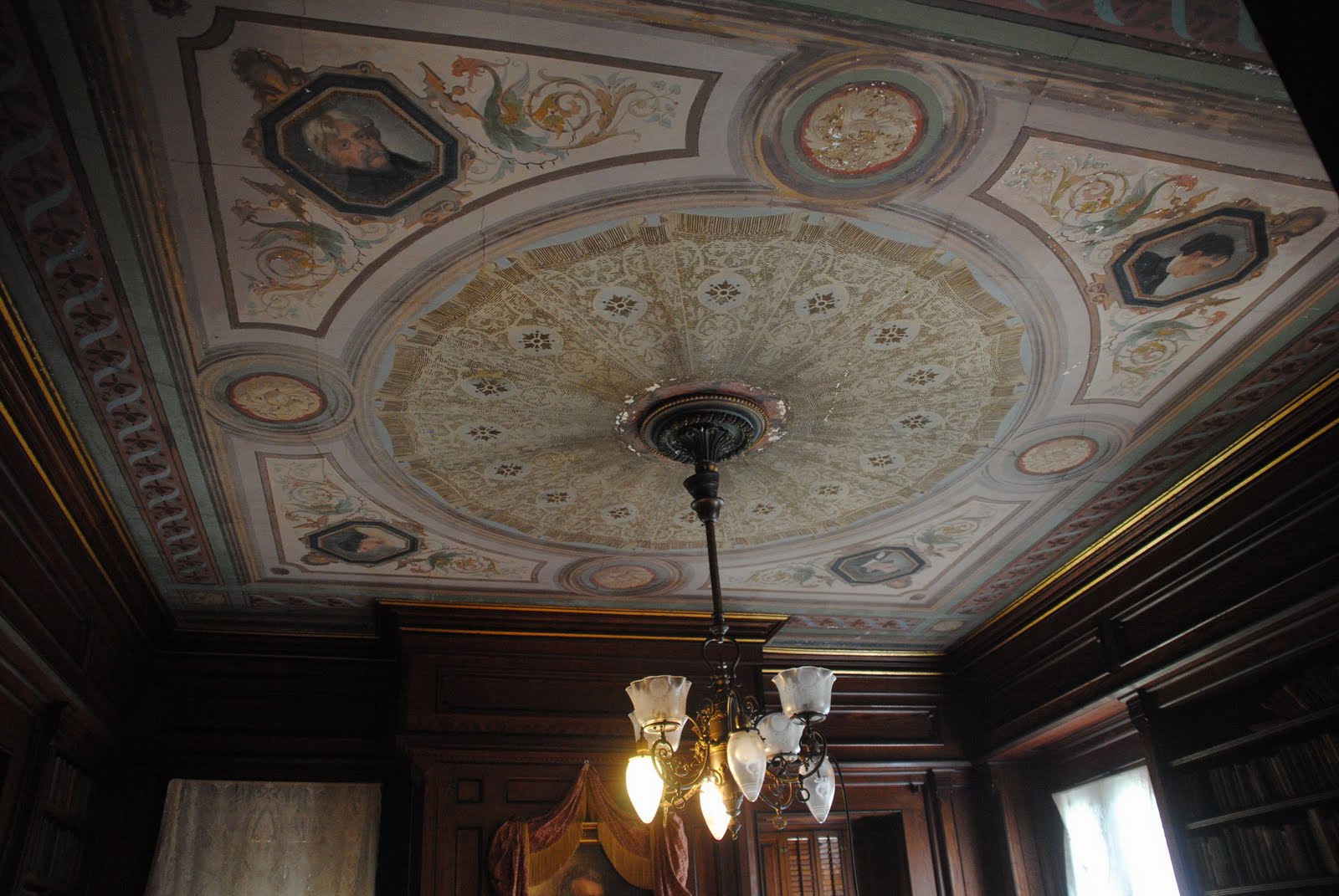
The five bas relief sculptures along the exterior walls depict Garfield's life as a teacher, soldier, legislator and president.  Many of these elements can be seen in the murals inside the memorial as well.  Stained windows are numerous, easily seen from both outside and inside.  The entrance to the memorial offers grand murals painted on the walls, intertwining nicely with stained glass windows throughout the structure.

Winding staircases lead to the crypt below, the observation balcony above and the upper level where you can gaze down upon the statue of Garfield in the inner room.  Every inch of the memorial appears to have paint, tile, marble or other decorative aspects.  I found it strange that one of these large murals depicts the assassination being carried out.

The stairs leading up narrow and twist as you climb to the observation level.  But the reward is worth the effort, as the large terrace gives a sweeping view of the lake and downtown Cleveland.  It would be intriguing to see photographs taken of the skyline over the last 100+ years from this spot.  Lakeview at first seems a deceiving name for the cemetery, as the entrance and grounds are over a mile inland from Erie's shores.  But Garfield's memorial at one point easily would have looked out over the lake before development altered site lines.


The crypt in the basement contains the caskets of Garfield and his wife, plus the ashes of his daughter and husband.  There are those who believe the ghost of Garfield haunts the crypt, reporting strange lights from the basement.  Allegedly Garfield haunts his former home, Lawnfield, in Hiram as well as the House of Representatives in Washington. 

If one were not knowledgeable about American History and our presidents, it could easily be thought that Garfield was one of the nation's strongest leaders by the sheer magnitude of his memorial.  McKinley's, by comparison, is not nearly as grand but he does have a sprawling museum and presidential library.  Perhaps Garfield could have been one of our top 10 president's, but his fate was intertwined with that of many Ohioan's that occupied the Executive Mansion.  Of Ohio's eight claimed presidents, half did not complete their term as president due to death in office.  Garfield was the first assassinated, as will be McKinley just short of 20 years later, with William Henry Harrison and Warren Harding dying in office from illness.  Like Harrison, Garfield did not manage to complete a full year.

Perhaps the magnitude of the structure is necessary, as Lakeview is a sprawling cemetery with little help in finding the grave sites of Cleveland's movers and shakers.  A little help on Google map is useful to scout the location before a visit.  But for someone who so briefly occupied the memory of the people as President, his memorial will continue to surprise those who did not realize this grand structure existed nor has stood for a century.

- J .


View Larger Map

Sunday, October 30, 2011

Chasing the Civil War in Ohio

Nestled among ballfields, businesses and major roads is Camp Chase
Ohio had but a few skirmishes during the four years of Civil War between 1861 and 1865, but Ohioans featured prominently in the war.  The third most populated state at the time, Ohio also sent the third most men for the Union Army, but it was leaders such as Grant, Sherman and Sheridan that had a more enduring legacy in the annals of the war.  But Ohio was also home to prisoner of war camps and on the west side of Columbus, nearly invisible to the passing commuter, history lies quietly among ballfields and businesses of the growing capitol of the state.

Established as a training ground along the national road in 1861, Camp Chase served as the temporary home for over 150,000 Union soldiers prepping to fight the Confederates.  Named for former Governor, and then-current Secretary of the Treasury Salmon Chase, the first southern prisoners were higher ranking Confederates who, with an oath of honor, were allowed to wander the City of Columbus. Security soon changed and many of these officers were sent north, to Johnson Island in Lake Erie.

Markers crammed into locations
The reason any remnants of the camp still exist was the 25,000 southerners were passed through the facility as prisoners of war.  As the war drew to an end in 1865, over 9,000 soldiers were still held captive and today over 2,000 gravestones mark those who perished within the walls.

As a prison, Camp Chase was originally situated to hold about 3,500 prisoners but quickly swelled to twice that size.  Upgraded through prison labor to hold 7,000 some believe 10,000 were crammed in the camp by war's end.  At war's end, the Camp quickly was vacated and structures removed.

In 1895 first memorial services were held, started by former Union soldier William Knauss.  A chapter of the Daughters of the Confederacy has sponsored a plaque in his honor along the south wall.  Originally the grave markers had been wooden but at some point around the turn of the century, the official U.S. markers given to all veterans replaced the original markers.

In 1902 a memorial arch was added and remains today, and is the only visible element of the cemetery as motorists and pedestrians pass along Sullivant Ave (the camp's former southern boundary).  Iron gates atop a four foot wall obscure that this is a historic landmark that today is little more in length than a football field in length and breadth.  Atop the monument stands a soldier, symbolically looking south, but with the word "Americans" atop the arch and below the statue.


With little explanation, a confederate cannonball fired at The Battle of Vicksburg and memorial stone stands near the entrance to the cemetery. Donated by a retired member of the Army, no on-site explanation is offered for its presence.  Google searches offer no help as well.

There are those who believe ghosts still haunt the cemetery.  The renowned Lady in Grey is the foremost spirit viewed walking the grounds.  Other mid-Ohio paranormal groups allege ghost activity on the grounds. A descendant of the Lady in Grey disputes these stories.

Ohio historical signage
More poignantly, as Ohio and the country look to commemorate the 150th anniversary of America's deadliest war, the cemetery stands as a reminder of the many forms of suffering that the war brought to a young nation.  Through Camp Chase passed the likes of Ohio's future presidents in Hayes, Garfield, McKinley as well as non-native, but at the time soon-to-be president Andrew Johnson.  The physical structures of the one-time camp may be ghosts to history, but the gravestones of scores of soldiers stands steadfast as today's commuters march on by.

- J.

Wednesday, August 3, 2011

Castles among the Corn

The front of Mac-o-Chee Castle
Among the sprawling fields of soybeans, among what was corn and wheat, stand a pair of castles that conspicuously stick out as you travel State Route 287 through Union County just northwest of Columbus.  What was once the lands of the Shawnee Indians, a pair of brothers built on a grand scale just a mile apart from each other in the post Civil War years in Ohio.  The Piatt Castles, called Mac-o-Chee and Mac-a-Cheek Castles, are off the beaten path but an interesting bit of Ohio History and why the state has and still is a destination location.

Library of Mac-o-Chee
The Piatt family was involved in early Ohio politics and trading along the Ohio River.  Benjamin Piatt served as a judge in Cincinnati but later moved the family to Logan County where Donn Piatt was raised.  Donn was educated in Cincinnati and moved on to Washington, DC, where he became heavily involved in political causes as a lawyer and newspaper columnist.  An ardent abolitionist, Piatt served in the Civil War as chief off staff to General Schenck in Maryland.  At a moment when Schenk was temporarily away from his post, Piatt is said to have issued an order to enlist only negro slaves in Maryland into the army which would have served to emancipate all of them.  Lincoln is said to have berated Piatt and forced his resignation from the army.  In the years following the Civil War he was quite an inflammatory character towards Presidents Grant and Hayes.


Piatt had the castle Mac-o-Chee built with state of the art technology of the time. Screened windows were patented in the early 1880s and Mac-o-Chee not only uses window screens but unique half-round transom screens above the doorways.  Indoor plumbing was not common at the time, but the home has unique first flushing commodes.

The home fell out of the Piatt family in the 1900's and was used,  unbelievably, as a barn for a local farmer who purchased the property for the land and not the house.  The fanstastic wooden floors have been carefully refurbished but still bear a place where the tractor stored in the "barn" irreparably stained the floor.

As eccentric as the home appears from the road, it was fitting that the home was saved by another eccentric individual.  An unwed daughter of Asa Griggs Candler, the founder of Coca Cola, was traveling through Union County in the 1950s and stopped at the castle and ended up purchasing the house.  One room today bears some of the furniture that she purchased to stock the home, as a castle home should have furniture you would find in a castle.

Mac-o-Chee today shows the wear and tear of a 100+ year old home.  The original paints on the walls and ceilings are fading and chipping.  While a historic home, funding doesn't appear available to speedily restore the home to its one-time splendor.  The tour of the home is mostly self-guided after a staff member gives a basic history and context introduction for the visit.

Abraham Piatt's Mac-a-Cheek
No more than two minutes down the road is the sister castle, Mac-a-Cheek.  Both castle names are derived from the Shawnee language that means "smiling valley."  Donn's brother Abraham built Mac-a-Cheek a bit farther from the road, but this did not stop visitors in the early 1900's from wandering the grounds and then asking to tour the castle.  Abraham thought that if he began charging for tours, which at the time consisted only of the front room of the house, that it would deter tourists.  The opposite occurred.

While the home incredibly stayed in the family for 6 generations, tours continued and it is believed to be the oldest home in Ohio with continuous running tours.  As time marched on, the family receded to other areas of the house and opened up more of the house for tours.  The most impressive room in the house is the grand parlor, which is the size of two or three regular sized rooms and like the sister castle Mac-o-Chee also has painted ceilings and intricate wood working on the floors and walls.
Today one or both homes can be toured.  Mac-a-Cheek in 2011 has a set up an impressive display of Civil War artifacts on the second floor of the home as a commemoration of the 150th anniversary of the Civil War.  A local resident created a diorama of a Virginia battle where an ancestor perished.  The amount of Civil War relics rivals or surpasses that of many larger museums while being restricted to two adjoining rooms. 
Mac-a-Cheek doesn't have tour access to the third floor or towers, while Mac-o-Chee does.  There are allegedly stories of ghosts at Mac-o-Chee.  There are also You Tube videos of the houses in modern times and a 1950s home movie that shows Mac-o-Chee.

Two castles amidst what used to be field of corn, still standing today as a symbol that Ohio once was home to those with powerful national ambitions but wanting to call home a place in the heartland.

J.


View Larger Map

Tuesday, September 22, 2009

Battle on the Ohio-Erie Canal

While the Civil War was primarily waged in the South there were skirmishes in Ohio, most notably Morgan's Raids into southern Ohio where a marker stands near a conflagration. But on an early fall weekend along the Ohio and Erie Canal, a battle waged that looked and felt like a step back into the 1860s.

Zoar Village is a living history village overseen by the Ohio Historical Society. Nestled along the Ohio and Erie Canal in northern Tuscarawas County, Zoar was a communal village that existed between the early 1800s and the late 1890s [see previous entry]. When you couple a historic village, replete with Victorian age homes and buildings that have been restored, with a passion for re-enacting the Civil War, you get a weekend unlike any other.

The Battle on the Ohio-Erie Canal puts over 1,000 re-enactors for a weekend encampment in this historic place. Camps were pitched throughout the town and as you walk the streets you could get a sense of real history. This is what many places looked like during those war-torn years. Fittingly the units portraying the north were camped along the northern edges of the village and the rebels the southern and western parts. While walking along one set of tents, marveling at how authentic the scene looked against a home built in the mid 1800s, you still can chuckle seeing a 2008 Mustang parked in the driveway.

What sets this re-enactment apart from many others is the air of authenticity of the village. It feels like this is the way things should look. Even a baby being pulled along in Victorian-age baby carriage did not seem to strike me as unusual. Although later walking through House #1 in the Village and the display in one room of Victorian baby gear (a kind of 1860s Babies R Us display) made me think of checking close to see if one of the carriages was missing.

Walking among the Sutlers (for non-Civil War folks, these are the merchants that trailed armies, selling them the wares they did not get from the Army), the sounds of a fife and drum unit demonstrating their military purpose could be heard wafting among the smells of kettle corn and other modern concessions. Certainly an unusual juxtaposition of vintage and contemporary! The care and detail the living historians take to present both military and civilian life in the Civil War is inspiring. These musicians range in age from elderly to juvenile and are as serious about their reproduction period pieces as any musician is about their modern instrument.

The earthen dam constructed by the Army Corps of Engineers to protect the village from flooding provided terrific theater seating for both demonstrations of artillery and cavalry fighting and the actual battle itself. A demonstration by the Battery A, 1st Ohio Statehouse was a special treat, as the highly polished bronze cannon is one of those on display of the ground of the Ohio Statehouse [see previous entry]. On Saturday night of the event weekend a dusk fire-off was held that provided the equivalent of a fireworks show for spectators. From a distance of about 30 miles I could hear the cannonade in my Stark County home!

It is a rare treat to watch a cavalry demonstration, as re-enacting is expensive enough to do as an infantry unit but a unit with horses brings a new level of cost and care [see previous entry]. The 6th Ohio Cavalry portrays both Yankee and Rebel units and demonstrated several cavalry tactics and manuevers, which was no small feat on the slope of a hill and a small plateau rife with gopher holes.


It is amazing to see how well trained the horses are and can only imagine and the sheer number of these animals used during the actual war. The unit spokesperson who led the public through the demonstration while on his own horse equated the use of the animal to how we treat our cars today. Cavalry horses were worked hard and not necessarily treated any better than the old beat up Chevy in the driveway. It was also neat to see just how much fun the re-enactors had in engaging each other in this demonstration.

The terrain offered a great, albeit condensed, view of how many of the battles during the Civil War played out. A Union skirmish line took on advancing Confederates, who wove through a field of goldenrod to reach the battlefield. The open fields offered a great vantage point to see the tactics of the time. Cannon exploded from the hilly and wooded slopes surrounding the field, adding an air of authenticity from a visual, acoustic and aromatic standpoint.


It is a combination that needs to be experienced: the authentic village hosting authentic living historians. Although it occurs bi-annually, it is well worth a day, if not two, to wander the village, order some bread from the still operating bakery, spend a night in a historic bed and breakfast and absorb all that was during a time very long ago when advancing armies engaged each other not far from a crossroads in America.

- J.