Showing posts with label cleveland. Show all posts

Sunday, February 19, 2012

A Corner of the Square for Public Pride

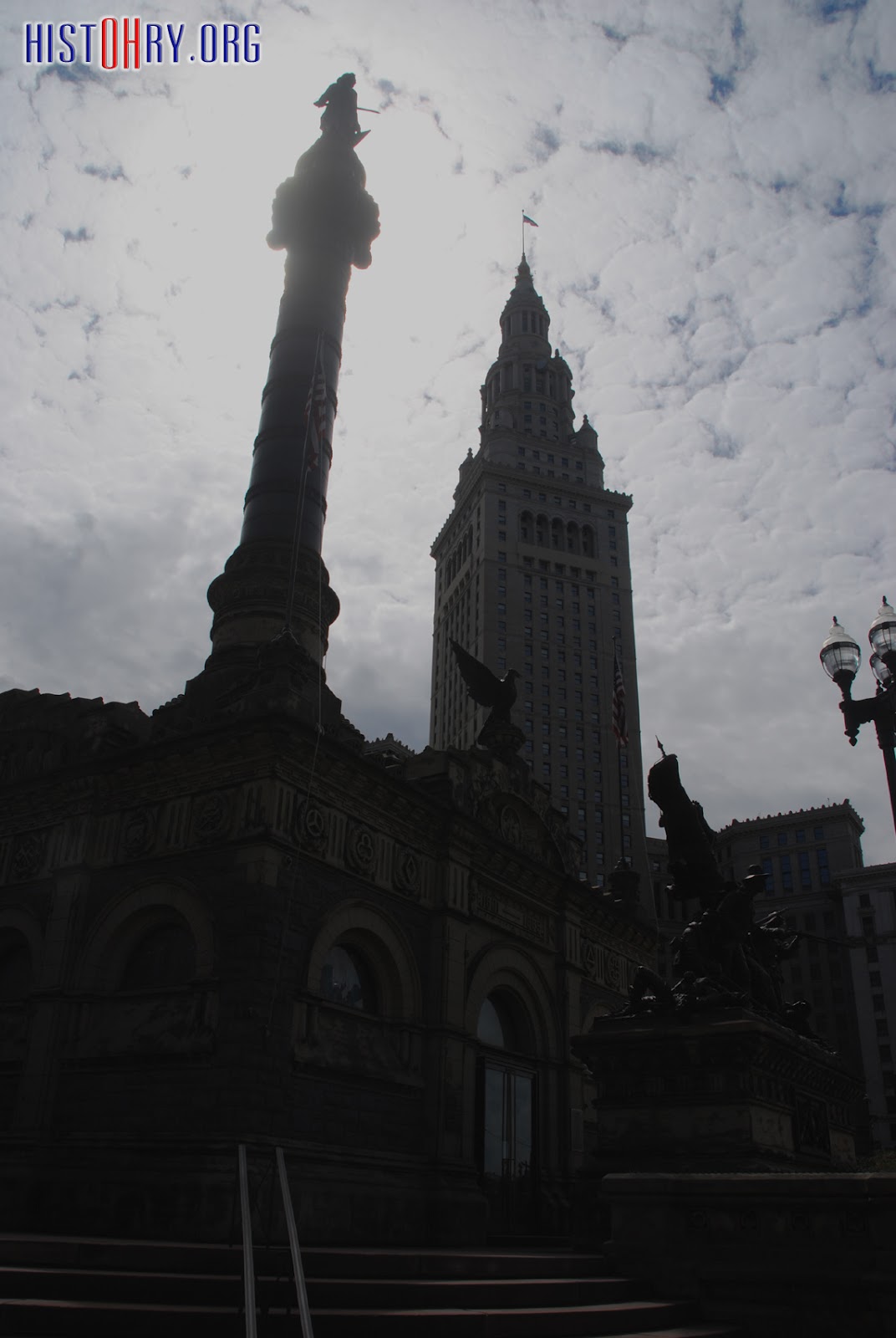
Often overlooked on Downtown Cleveland's Public Square is a small little memorial at the base of a large monument dedicated to those from the city who fought in the Civil War.  The Soldier's and Sailor's Monument occupies one of the four plotted greenspaces on the square, but few wander into the base to view the full memorial.

The 9.5 acres that encompass Public Square was laid out in the late 1850's.  As the Civil War broke out, city planners had dedicated a small monument to Oliver Hazard Perry, hero of the Battle of Lake Erie in the War of 1812.  Perry's Monument has been well-traveled, having been moved on the square, then later to two other locations before being re-cast in bronze and placed near the Cuyahoga County Courthouse.

Public Square in the early 1900s

Perry's Monument was moved in the 1870s to make way for a grand Civil War memorial on one of the four quadrants.  The other sections of the square included a statue to founder Moses Cleaveland and Tom L. Johnson, a former Congressman and Cleveland Mayor.  Electric street lighting was debuted on Cleveland's Public Square in 1879.  By the end of the first World War in 1917, Public Square had seen its heyday.

As the City's Skyline grew throughout the 1900s, Public Square became more of a transportation center than public park.  The Terminal Tower, built in 1928, stood atop the rail connections for the city and anchored the square.  For 25 years it stood as the tallest building outside of New York City. It remained Cleveland's tallest structure, despite a competing high-rise built in the 1980s as the BP (Oil) Building (which in 2012 is the Huntington Building). 

As Ohio's economy stumbled along through the second half of the 20th Century, several retail attractions failed to turn the square into anything more than a mass of people catching busses for the two sections of the city.  The May Company operated a store attached to the Terminal complex until the 1990s and for a brief time in the 1990s, Tower City Center was one of the niche urban-renewal upscale shopping experiences that quickly faded.

The Cuyahoga River, splitting the city, also splits the demographics of the metropolitan area.  East Siders and West Siders primarily live and shop within their respective sides of the city.  The near west side was a melting pot of Slavic, Italian and Polish immigrants while the east side saw growth of primarily African-American families.  Public Square was the gathering place for those who came into the city for business or recreation, looking to catch their bus back home.

Economic development eclipsed the Terminal Tower in 1991 when then-Society Bank built a structure to the north of Public Square that today stands as the Key Tower and the tallest structure in Cleveland.  It is these three grand structures that surround the Soldiers and Sailors Monument on Public Square.

The Soldiers and Sailors Monument was renovated in the 1980s but still sees scant foot traffic and remains a bypassed attraction.  The base of the monument is a 100-square foot sandstone structure topped by a 125-foot granite shaft with a 15-foot sculpture at the top.  The base is surrounded in the cardinal directions by groupings of bronze sculptures that depict each of the branches of the Union Army: Navy, Cavalry, Infantry and Artillery.  The entire monument was designed by Cleveland architect Levi Schofield, whose bust can be seen atop the entrance as you exit the memorial.

The interior of the building is small and a self-guided tour of the monument can be done in minutes.  A series of marble tablets list 9,000 Civil War veterans that served with Cuyahoga County regiments or were from the county. Also inside the base are four bronze relief sculptures depicting the women in the Soldiers' Aid Society, Lincoln (with rifle and busted chains) emancipating the slaves, and the beginning and ending of the War in Ohio.  Also found atop the interior by stained glass half-round windows are the busts of Col. James Barnett, Scofield, and several Ohio officers who were killed in action during the war.


There are grand plans for turning Public Square back into a true public open space.  Ideas were put on the table in 2009 and 2011 to alter traffic patterns with the hopes of created a newly purpose, and potentially, greener venue. 

Ohio voters in the late first decade of the 2000's approved for Casinos in the state and Cleveland will debut one in 2012 in the former Higbee's Department store that is just off Public Square. With the increased interest in the Downtown area it remains to be seen if Public Square and the Soldiers and Sailors Monument, will factor in that development.

- J.

Sunday, January 15, 2012

Garfield's Short Term and Long Term Memory

Ohio's history with presidents is unique in many ways.  We claim, along with Virginia, eight presidents as our own.  Few doubt Virginia's importance in the early years of our nation, but many wonder why so many from Ohio?  James A. Garfield's grand memorial at the historic Lakeview Cemetery in Cleveland presents an excellent case study as for the long and the short of Ohio's place in American presidential history.

Garfield, like fellow Buckeye Presidents Grant, Hayes, Harrison and McKinley, served in the Civil War with notable distinction. Ohio being a growing state in Victorian America, with Cincinnati being the largest city west of the original 13 states, her influence on the political scene rivals what large populous states of New York, Texas and California are today.  War service, along with Ohio's national prominence, is why seven of the twelve presidential terms served between 1869 and 1923 had an Ohioan in the White House.


James A. Garfield served but 200 days but you would think he served two full terms by his legacy at Lakeview Cemetery.  Like his executive colleague's resting place an hour south, Garfield's memorial rises high into the sky, easily dwarfing William McKinley's structure in Canton.  However, both offer sweeping views of their adopted cities seen through considerable climbing of steps.  McKinley's steps lead toward his lofty memorial, while Garfield's wind through the inner structure and lead to an impressive exterior balcony.

Walking around the structure, the native Ohio sandstone shows the weathering of time against Lake Erie's wind, rain and snow.  Construction surprisingly began a mere four years after Garfield's assassination, was completed by 1889, was added to the National Register of Historic Places in 1973 and received a half-million dollar grant for renovations in 1985.  Time has blackened the three tier, 180-foot structure and exterior sculptures, but fits in appropriately with the surrounding cemetery grounds.


The five bas relief sculptures along the exterior walls depict Garfield's life as a teacher, soldier, legislator and president.  Many of these elements can be seen in the murals inside the memorial as well.  Stained windows are numerous, easily seen from both outside and inside.  The entrance to the memorial offers grand murals painted on the walls, intertwining nicely with stained glass windows throughout the structure.

Winding staircases lead to the crypt below, the observation balcony above and the upper level where you can gaze down upon the statue of Garfield in the inner room.  Every inch of the memorial appears to have paint, tile, marble or other decorative aspects.  I found it strange that one of these large murals depicts the assassination being carried out.

The stairs leading up narrow and twist as you climb to the observation level.  But the reward is worth the effort, as the large terrace gives a sweeping view of the lake and downtown Cleveland.  It would be intriguing to see photographs taken of the skyline over the last 100+ years from this spot.  Lakeview at first seems a deceiving name for the cemetery, as the entrance and grounds are over a mile inland from Erie's shores.  But Garfield's memorial at one point easily would have looked out over the lake before development altered site lines.


The crypt in the basement contains the caskets of Garfield and his wife, plus the ashes of his daughter and husband.  There are those who believe the ghost of Garfield haunts the crypt, reporting strange lights from the basement.  Allegedly Garfield haunts his former home, Lawnfield, in Hiram as well as the House of Representatives in Washington. 

If one were not knowledgeable about American History and our presidents, it could easily be thought that Garfield was one of the nation's strongest leaders by the sheer magnitude of his memorial.  McKinley's, by comparison, is not nearly as grand but he does have a sprawling museum and presidential library.  Perhaps Garfield could have been one of our top 10 president's, but his fate was intertwined with that of many Ohioan's that occupied the Executive Mansion.  Of Ohio's eight claimed presidents, half did not complete their term as president due to death in office.  Garfield was the first assassinated, as will be McKinley just short of 20 years later, with William Henry Harrison and Warren Harding dying in office from illness.  Like Harrison, Garfield did not manage to complete a full year.

Perhaps the magnitude of the structure is necessary, as Lakeview is a sprawling cemetery with little help in finding the grave sites of Cleveland's movers and shakers.  A little help on Google map is useful to scout the location before a visit.  But for someone who so briefly occupied the memory of the people as President, his memorial will continue to surprise those who did not realize this grand structure existed nor has stood for a century.

- J .


View Larger Map

Saturday, July 31, 2010

What's the Mather with Cleveland?


Docked neatly behind the Rock and Roll Hall of Fame and Great Lakes Science Center is a vessel said to have built Cleveland. The William G. Mather (see left, click to enlarge) was a steamship built in 1920s for the Cleveland Cliffs company, which moved tons of iron ore and other materials around the Great Lakes. Today the Mather is a floating museum attached to the Great Lakes Science Center.

William G. Mather was an industrialist who served as the head of Cleveland Cliffs for over 50 years. The Mather was the flagship of the company's lake freighters and would bring to Cleveland iron ore from Minnesota which would then be processed into steel at the many plants located in Cleveland. Fittingly, the Mather now looks out over the skyline (see right, click to enlarge) that it helped create and is open to both guided and self-tours.

Navigating the Mather is not a simple task, as there are steep ladders and low overheads despite the cavernous interior that would hold tons of cargo. As the flagship of the fleet, the Mather also could carry several passengers in quarters that aren't too far off cruise ship standards (for the time).

The ship (nautical data here) has two housings between its 600+ foot series of cargo holds. The aft housing is the location of the engine room, galley and state room as well as crew quarters.
The front housing is where passengers, the captain and mates were housed as well as the bridge. The captain's quarters featured two rooms, one being the bedroom and the other an office area (see right, click to enlarge) . There is also private interior stairwell to quickly get the captain up to the bridge without having to be exposed to the weather.

The bridge gives a 360-degree view (see left, click to enlarge) and with surprisingly few navigational needs when compared to touring Navy vessels of similar size.

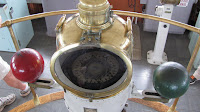
Standing at the wheel, the compass
looks a little like a science fiction device as the massive bronze hood covering the compass is flanked by two colored iron balls. These two devices help aid in re-calibrating the compass, for when you are carrying tons of iron ore the compass is going to have some issues bearing true north. (see right, click to enlarge)

While the handful of passengers would sail in nicely accommodated cabins, all dining happened aft (see right, click to enlarge). That can make for a tricky walk back along the deck, as the railings were minimal and wire. For crew safety, there is a cable running the length of the ship where sailors would tie into. Should the unexpected happen and a person pitched overboard, the safety lines would keep one from truly going over and into the lake.

The engine room (see left, click to enlarge) is a three story area and must have been quite loud. Originally a pure steam-driven engine, it was later converted to an automated boiler system, the first for any lake freighter. She was also among the first lake vessels to incorporate radar. On the deck above the engine room at the stern of the ship is another set of pilot wheels to be used for navigating the snaking rivers that emptied into the lakes.

The Cuyahoga River is one of those snaking rivers and Great Lakes freighters were designed accordingly. There are propeller-driven blowers, two aft and two forward, that face outward at the water line for navigating these tricky turns. (see left, click to enlarge)


Standing at the rear of the Mather looking out into the lake, one can see what at first glance appears to be a ship on the horizon.
But looking closer it is a structure and not a ship. A peek through a mounted telescope, provided for tourists, reveals that this is the intake station for the city of Cleveland's water supply, laying about a mile beyond the shelter of the breakwall. (see right, click to enlarge)

While sailing the Great Lakes isn't as adventurous or appealing as sailing around the world on the open seas, the Great Lakes can be equally dangerous and unforgiving. The legendary wreck of the Edmund Fitzgerald, fabled in song by Gordon Lightfoot, is testament to the perils of the open waters. One of the cargo holds serves as the entry point on the ship and has a gift shop and learning stations as well as a display on the Edmund Fitzgerald (see left, click to enlarge) . But for all the dangers, lake freighters serve as an efficient method of shipping, as one of the displays in the cargo hold show a fully loaded lake freighter can haul the equivalent of 700 rail cars and 2,800 trucks.

- J.

Wednesday, July 29, 2009

A Honking Good Time in the Western Reserve

The University Circle area east of Cleveland (map, wiki) is a mecca for culture, featuring numerous museums, the Cleveland Institute of Music, Severance Hall (home to the world renown Cleveland Orchestra) and Case Western Reserve University. Picking the right date on the calendar can land you access to most of the Wade Oval museums for free or special community concert events as part of a community outreach event. The museums on the oval include the Botanical Gardens, Natural History Museum, the Western Reserve Historical Society and the (always free) Cleveland Museum of Art.

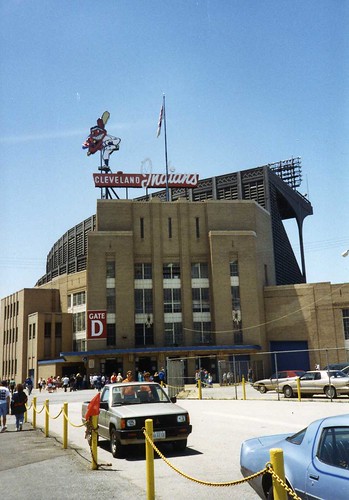
The Western Reserve Historical Society (WRHS) also houses the Crawford Auto-Aviation Museum (see right, click to enlarge) as well as a significant genealogical library. Housed in part of the old Hanna Mansion, the museum is an unusual mix of the old and not-so-old and always features unique temporary exhibits. A personal favorite is the permanent display of the 2-story, neon Chief Wahoo sign from the old Municipal Stadium in Cleveland (see left, click to enlarge). Standing high atop Gate D, it was the entrance point for many children into the world of professional sports downtown during the 1930s through the 1980s (see web picture).

2008 through June 2009 saw an exhibit on women’s and children’s clothing in history (see right, click to enlarge). From colonial times in the Western Reserve (roughly and geographically speaking the Northeast quadrant of Ohio) through the mid-20th Century, this gallery is tucked into a corner of the Bingham-Hanna Mansion section of the museum.

There was also recently a temporary exhibit dedicated to Carl and Louis Stokes. The Stokes brothers were significant early Africa-American pioneers in politics on the large urban level and on the national scene (see left, click to enlarge). Carl was one of the first African-American mayors of a major metropolitan city (Cleveland) and his brother Louis a member of the U.S. House of Representatives. The exhibit showed many unique reproductions of photos and news stories, as well as artifacts significant to African-Americans in Ohio during the tumultuous Civil Rights era.

Wandering through the permanent displays en-route to the temporary galleries in the back portion of the museum winds the visitor through an eclectic mix of history. Archibald Willard’s famous painting from the Revolutionary War, The Spirit of ’76, Colonial picture-letters used to teach reading (creatively forming “WRHS”), a Depression-era carousel horse and other varied historical records from the region (from local African-American newspapers to land grant maps of Bath Township in Summit County) and more grace the wings connecting the main lobby and the temporary exhibits (see right pictures, click to enlarge).

There are more than static displays, as a hands-on “Victory Garden” from World War II beckons younger children and students and invites them to participate with their own gardening at home (see left, click to enlarge).

But the kid in every adult is brought out in the basement, which houses a partial collection of the wide-ranging types of cars that comprise the collection of the Crawford Auto-Aviation Museum (see right, click to enlarge). From early “horseless carriages” to modern sports cars, the mix of wood, steel, chrome and leather beckon. Along one of the walls is a type of “street of dreams” that looks the part of a turn-of-the-century main street.

Depending upon the usage of the other galleries, some of the collection can be viewed on the main level as well. On this particular visit stainless steel was a theme of a segment of a gallery that housed a DeLorean (made famous in the Back to the Future movies from the 1980's) and other unusual vintage cars of stainless steel or brushed nickel finish. Along the same gallery were several planes, including a vintage P-51 Mustang.

Some say that visiting a history museum is a bland walk through historical artifacts; a place to wander and gaze at writings, costumes and furniture. But when a museum such as the Western Reserve Historical Society couples history of sizes, shapes, and perhaps just as importantly, speed there is bound to be a little adrenaline coursing through the body.
-J.
Wednesday, April 8, 2009

Interactive Science on the Lakefront

Cleveland may lack the historical panache of cities like Boston, Philadelphia, Washington D.C. or Baltimore and may fall short of the artistic and economic giants of New York City or Chicago. But what the meager lesser skyline of Cleveland (see right, click to enlarge) may lack between east and midwest, you will be hard pressed to find a better museum dedicated to interactive, hands-on scientific learning and fun. The Great Lakes Science Center, or GLSC, (map, web) scores high on the list of must-see museums anywhere.

COSI in Columbus is nearly a twin-sister to GLSC
and is a mere 2 hours down the highway in a growing and expanding metropolitan area. Cleveland's exodus of industry and population over the last few decades have left as a main tourist attraction some fantastic, but also overlooked museums. Wade Oval in the University Circle area east of Cleveland is home to a handful of great family friendly museums, including the diverse big four of the Cleveland Museum of Natural History, the Western Reserve Historical Society (and Crawford Auto/Aviation Museum), Cleveland Art Museum and the Botanical Gardens.

The Great Lakes Science Center
(see left, click to enlarge) was brilliantly designed along the downtown waterfront and sits a good 50-yard field goal away from Cleveland Brown's Stadium and adjacent to the Rock and Roll Hall of Fame. Along with the move of the Goodtime III, a lake and river sightseeing cruise, to the 9th Street Pier has made this area a wonder spot for daily museum visits and the occasional festival, such as the Tall Ships gathering of clippers and other sail vessels.

While possible to do in single day, most families will probably not take in both the Rock and Roll Hall of Fame and GLSC the same day. Without blinking an eye, you can easily surpass three hours at GLSC, perhaps even four if you take in one of the thrice daily IMAX offerings. $15 for the center and IMAX for adults ($9 for children) is not out of line in today's economy. Even the $6 (after validation) for the urban parking deck that adjoins the facility is not unreasonable. But the $22/$13 (Adults/Children) admission for the Rock Hall of Fame makes a one-day double dip quite pricey. Too, I'm not sure younger children will get the same out of the Rock Hall that teens and adults will.

Adding to the sites to see on the block, the William Mather Steamship Museum (see left, click to enlarge), housed inside a retired Great Lakes freighter, is open during the summer months and is quite an impressive site in the harbor. If a full day is desired on the lakefront, add in a tour of Cleveland Brown's Stadium. It might possibly be the highlight of the Brown's year during a changeover of coaches and personnel in 2009!


The Great Lakes Science Center is neatly laid out on three floors. You will not have a ton of walking and the floor plan is very open (see right, and below left, click to enlarge). There are permanent and temporary exhibits, all very hands-on and kid friendly. On my visit, the temporary exhibits on robots had many displays and interactive activities including a way to make a "jitterbug" robot using Styrofoam and batteries. You could make one for free and leave it behind, or for a few dollars take your little robotic device home.

The "science" at GLSC varies from the mechanics principals such as simple machines (you can lift a junked car smashed to a block using a lever), investigate the science behind medicine (manipulate a mechanized prosthetic arm), marvel at the physics behind acoustics and light, and shock yourself (literally) with matters of energy and electricity. The lower level brings natural science of the Great Lakes into the museum with weather, water and other elements while you gaze out the windows at Lake Erie.

But GLSC makes the kids the stars of the show. From flying a hang-glider (virtually), to plucking the strings of a LED harp, flying a computerized biplane, and even being subjected to thermal imaging (see right, click to enlarge), kids will find much to their liking. Even the simple (by today's technology) blue-screen broadcasting of the weather puts the younger ones in the spotlight. On a nondescript mid-week day, there were several demonstrations led by GLSC staff, from science of bubbles to magic of matter and exhibit led demonstrations such as the static electric machine that gives a new meaning to the term "bad hair day."

Even the youngest can find science in their pursuit of play. The 7 and under play area is equally hands on and pursues science. The biggest attraction is the padded ball pit, where you can put balls into sand-box pails on a conveyor er belt (moved by hand of course), or stuff balls into a tube that launches them skyward, ultimately falling into a pair of clear scoops that can be opened and closed by little ones, plummeting the collection of balls back to the pit. There are many other play structures including an inflatable "bounce house" (see right, click to enlarge) for tots, preschoolers and even kindergartners to expend their own energy.

So much to take in and do in one day, that easily when leaving the youngest will fall quickly asleep and the older ones begin asking about the next visit. All along a lakefront that 20 years ago featured a nice seafood restaurant, a tepid, if not turbid, stadium that sat at the water's edge and not much else.

- J.