Showing posts with label Great Lakes Science Center. Show all posts

Saturday, July 31, 2010

What's the Mather with Cleveland?


Docked neatly behind the Rock and Roll Hall of Fame and Great Lakes Science Center is a vessel said to have built Cleveland. The William G. Mather (see left, click to enlarge) was a steamship built in 1920s for the Cleveland Cliffs company, which moved tons of iron ore and other materials around the Great Lakes. Today the Mather is a floating museum attached to the Great Lakes Science Center.

William G. Mather was an industrialist who served as the head of Cleveland Cliffs for over 50 years. The Mather was the flagship of the company's lake freighters and would bring to Cleveland iron ore from Minnesota which would then be processed into steel at the many plants located in Cleveland. Fittingly, the Mather now looks out over the skyline (see right, click to enlarge) that it helped create and is open to both guided and self-tours.

Navigating the Mather is not a simple task, as there are steep ladders and low overheads despite the cavernous interior that would hold tons of cargo. As the flagship of the fleet, the Mather also could carry several passengers in quarters that aren't too far off cruise ship standards (for the time).

The ship (nautical data here) has two housings between its 600+ foot series of cargo holds. The aft housing is the location of the engine room, galley and state room as well as crew quarters.
The front housing is where passengers, the captain and mates were housed as well as the bridge. The captain's quarters featured two rooms, one being the bedroom and the other an office area (see right, click to enlarge) . There is also private interior stairwell to quickly get the captain up to the bridge without having to be exposed to the weather.

The bridge gives a 360-degree view (see left, click to enlarge) and with surprisingly few navigational needs when compared to touring Navy vessels of similar size.
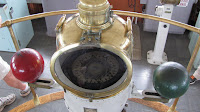
Standing at the wheel, the compass
looks a little like a science fiction device as the massive bronze hood covering the compass is flanked by two colored iron balls. These two devices help aid in re-calibrating the compass, for when you are carrying tons of iron ore the compass is going to have some issues bearing true north. (see right, click to enlarge)

While the handful of passengers would sail in nicely accommodated cabins, all dining happened aft (see right, click to enlarge). That can make for a tricky walk back along the deck, as the railings were minimal and wire. For crew safety, there is a cable running the length of the ship where sailors would tie into. Should the unexpected happen and a person pitched overboard, the safety lines would keep one from truly going over and into the lake.

The engine room (see left, click to enlarge) is a three story area and must have been quite loud. Originally a pure steam-driven engine, it was later converted to an automated boiler system, the first for any lake freighter. She was also among the first lake vessels to incorporate radar. On the deck above the engine room at the stern of the ship is another set of pilot wheels to be used for navigating the snaking rivers that emptied into the lakes.

The Cuyahoga River is one of those snaking rivers and Great Lakes freighters were designed accordingly. There are propeller-driven blowers, two aft and two forward, that face outward at the water line for navigating these tricky turns. (see left, click to enlarge)


Standing at the rear of the Mather looking out into the lake, one can see what at first glance appears to be a ship on the horizon.
But looking closer it is a structure and not a ship. A peek through a mounted telescope, provided for tourists, reveals that this is the intake station for the city of Cleveland's water supply, laying about a mile beyond the shelter of the breakwall. (see right, click to enlarge)

While sailing the Great Lakes isn't as adventurous or appealing as sailing around the world on the open seas, the Great Lakes can be equally dangerous and unforgiving. The legendary wreck of the Edmund Fitzgerald, fabled in song by Gordon Lightfoot, is testament to the perils of the open waters. One of the cargo holds serves as the entry point on the ship and has a gift shop and learning stations as well as a display on the Edmund Fitzgerald (see left, click to enlarge) . But for all the dangers, lake freighters serve as an efficient method of shipping, as one of the displays in the cargo hold show a fully loaded lake freighter can haul the equivalent of 700 rail cars and 2,800 trucks.

- J.

Wednesday, April 8, 2009

Interactive Science on the Lakefront

Cleveland may lack the historical panache of cities like Boston, Philadelphia, Washington D.C. or Baltimore and may fall short of the artistic and economic giants of New York City or Chicago. But what the meager lesser skyline of Cleveland (see right, click to enlarge) may lack between east and midwest, you will be hard pressed to find a better museum dedicated to interactive, hands-on scientific learning and fun. The Great Lakes Science Center, or GLSC, (map, web) scores high on the list of must-see museums anywhere.

COSI in Columbus is nearly a twin-sister to GLSC
and is a mere 2 hours down the highway in a growing and expanding metropolitan area. Cleveland's exodus of industry and population over the last few decades have left as a main tourist attraction some fantastic, but also overlooked museums. Wade Oval in the University Circle area east of Cleveland is home to a handful of great family friendly museums, including the diverse big four of the Cleveland Museum of Natural History, the Western Reserve Historical Society (and Crawford Auto/Aviation Museum), Cleveland Art Museum and the Botanical Gardens.

The Great Lakes Science Center
(see left, click to enlarge) was brilliantly designed along the downtown waterfront and sits a good 50-yard field goal away from Cleveland Brown's Stadium and adjacent to the Rock and Roll Hall of Fame. Along with the move of the Goodtime III, a lake and river sightseeing cruise, to the 9th Street Pier has made this area a wonder spot for daily museum visits and the occasional festival, such as the Tall Ships gathering of clippers and other sail vessels.

While possible to do in single day, most families will probably not take in both the Rock and Roll Hall of Fame and GLSC the same day. Without blinking an eye, you can easily surpass three hours at GLSC, perhaps even four if you take in one of the thrice daily IMAX offerings. $15 for the center and IMAX for adults ($9 for children) is not out of line in today's economy. Even the $6 (after validation) for the urban parking deck that adjoins the facility is not unreasonable. But the $22/$13 (Adults/Children) admission for the Rock Hall of Fame makes a one-day double dip quite pricey. Too, I'm not sure younger children will get the same out of the Rock Hall that teens and adults will.

Adding to the sites to see on the block, the William Mather Steamship Museum (see left, click to enlarge), housed inside a retired Great Lakes freighter, is open during the summer months and is quite an impressive site in the harbor. If a full day is desired on the lakefront, add in a tour of Cleveland Brown's Stadium. It might possibly be the highlight of the Brown's year during a changeover of coaches and personnel in 2009!


The Great Lakes Science Center is neatly laid out on three floors. You will not have a ton of walking and the floor plan is very open (see right, and below left, click to enlarge). There are permanent and temporary exhibits, all very hands-on and kid friendly. On my visit, the temporary exhibits on robots had many displays and interactive activities including a way to make a "jitterbug" robot using Styrofoam and batteries. You could make one for free and leave it behind, or for a few dollars take your little robotic device home.

The "science" at GLSC varies from the mechanics principals such as simple machines (you can lift a junked car smashed to a block using a lever), investigate the science behind medicine (manipulate a mechanized prosthetic arm), marvel at the physics behind acoustics and light, and shock yourself (literally) with matters of energy and electricity. The lower level brings natural science of the Great Lakes into the museum with weather, water and other elements while you gaze out the windows at Lake Erie.

But GLSC makes the kids the stars of the show. From flying a hang-glider (virtually), to plucking the strings of a LED harp, flying a computerized biplane, and even being subjected to thermal imaging (see right, click to enlarge), kids will find much to their liking. Even the simple (by today's technology) blue-screen broadcasting of the weather puts the younger ones in the spotlight. On a nondescript mid-week day, there were several demonstrations led by GLSC staff, from science of bubbles to magic of matter and exhibit led demonstrations such as the static electric machine that gives a new meaning to the term "bad hair day."

Even the youngest can find science in their pursuit of play. The 7 and under play area is equally hands on and pursues science. The biggest attraction is the padded ball pit, where you can put balls into sand-box pails on a conveyor er belt (moved by hand of course), or stuff balls into a tube that launches them skyward, ultimately falling into a pair of clear scoops that can be opened and closed by little ones, plummeting the collection of balls back to the pit. There are many other play structures including an inflatable "bounce house" (see right, click to enlarge) for tots, preschoolers and even kindergartners to expend their own energy.

So much to take in and do in one day, that easily when leaving the youngest will fall quickly asleep and the older ones begin asking about the next visit. All along a lakefront that 20 years ago featured a nice seafood restaurant, a tepid, if not turbid, stadium that sat at the water's edge and not much else.

- J.