Showing posts with label Lake Erie. Show all posts

Friday, July 29, 2011

Forgettable War, Unforgettable Fort


Inside Fort Meigs looking at a southwestern blockhouse
Who knew that Ohio boasts the largest historic fort site from the War of 1812?  For that matter, how many even remember there was a War of 1812? Lost among the shuffle of wars taught in the classroom history books, the War of 1812 often comes up short or even missing. But just outside Toledo, Ohio on the inland banks of the Maumee River stands Fort Meigs, an impressive structure that repelled not once, but twice the British invasion of northwestern Ohio.

The War of 1812 isn't as easy to understand as the Revolutionary War or the Civil War,  where causes seemed clear and a war inevitable. President James Madison in many ways was goaded into action from war-mongering politicians, who were tagged with the first use of the term warhawk, over issues involving British practices at sea and out west in the Great Lakes region. Throughout the nation a sizeable number of Madison High Schools today tout the Warhawks as their mascots.

Historic Marker and Visitor Center at Fort Meigs
For Ohio the War of 1812 was about Indians and Canadians, as both were immediate threats to the barely decade-old state. Fort Meigs was built to protect the interior of Ohio from coalition of English and French. The fort stands on the footprint of the original fort and features a nicely sized museum and visitor center. Built in 2003 as part of Ohio's Bicentennial celebrations, the winding displays give a great sense of the timing of the war and the artifacts of the time and those found at the site. A corner of the museum shows how modern science, including thermal imaging was used in renovating the fort.

Costumed interpreter reacting to musket demonstration
A visit on the right day might begin with a tour of the musuem by a costumed interpreter. On this visit the interpreter, a college-aged girl, remarked that in the 19th Century she did not have the right serve her country as a soldier but in the 21st Century does, including re-enacting one.

Fort McHenry in Baltimore certainly gains all the publicity and attention for the War of 1812, having been the site where Francis Scott Key penned the words to the Star Spangled Banner and what would later become the National Anthem.  But Fort Meigs is supersized in comparison to her east coast companion's star shaped designed.  Meigs is spread out over what could encompass two to three city blocks, with sturdy blockhouses every several hundred feet.

One of the eight blockhouse of Fort Meigs
These blockhouses not only served to repel Indian and British forces during the two sieges between May and July of 1813, but later housed pioneer families coming to northwest Ohio while their own homes were built.  Lore has it that one family, late in arriving and unable to secure housing in a blockhouse, set fire to the blockhouse.

Canon portal inside ground floor of a western blockhouse
The walls of these structures are several feet of solid wood with rifle portals that angle inward, giving a small outward target but inside the blockhouse a wide angle to swivel a gun for better accuracy.  A small cannon rests in the middle of the main floor room of each blockhouse with a narrow opening for firing outward.  Today the opening masks the intended view as tall grass obscures a view towards the river.
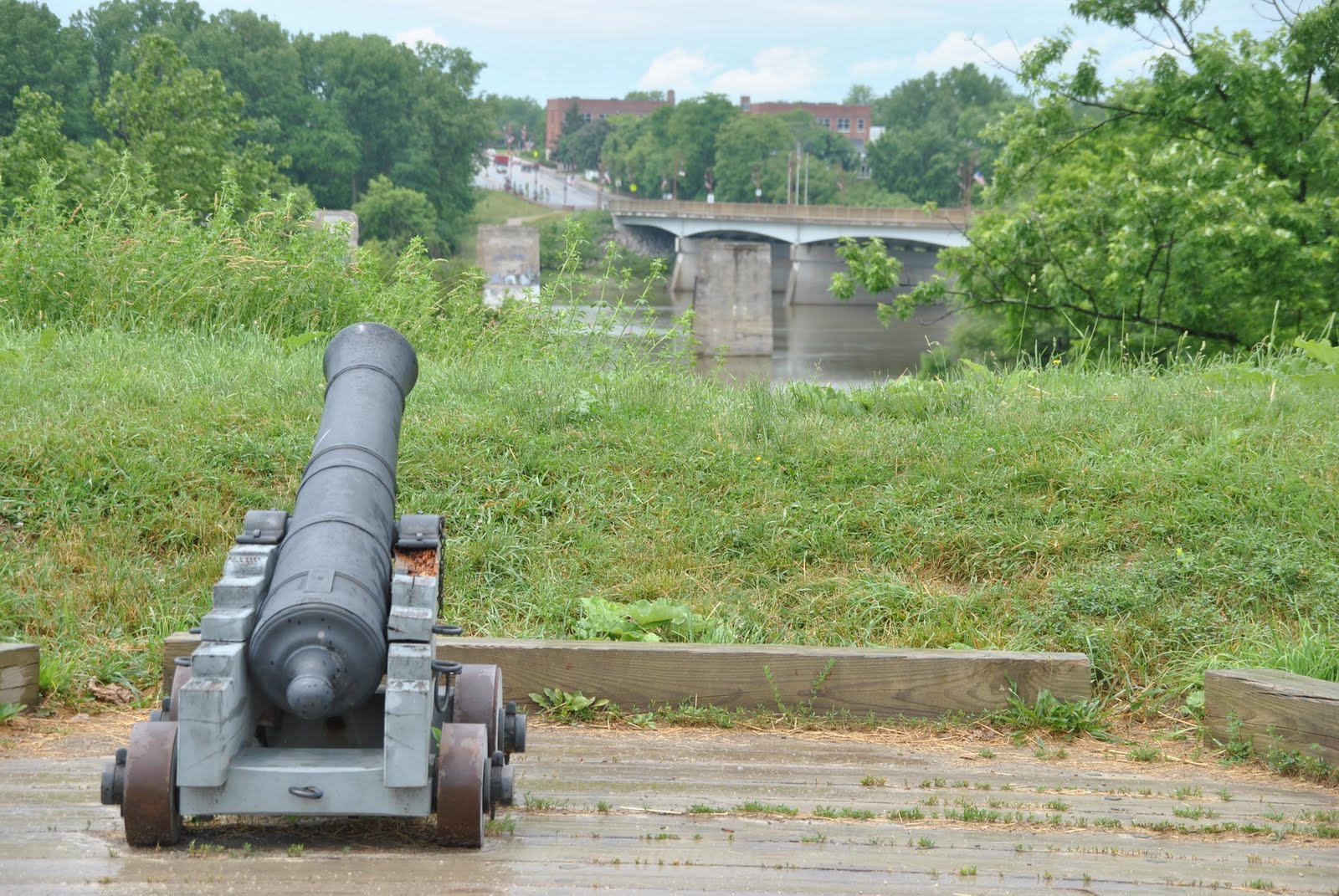
Croghan's Battery overlooking the Maumee and Perrsyburg
Each of the blockhouses today houses a different story about the fort, from soldiers quarters, disease and the role of women, to the science of artillery and a diorama of the fort's early construction. Artillery is a large part of the fort's story, defense and modern re-enactments. Each July 4th costumed interpreters hold a grand series of events, including a cannon fire demonstration on the grounds (click for video).

A series of large mounds were built within the interior of the fort to serve as buffers to artillery attacks from outside the walls and to also for fort storage, including powder magazines.  In 1908 a 100-foot monument to the war and the fort was erected, funded by the Grand Army of the Republic (a Civil War veteran's organization).


WPA Shelter House seen through blockhouse window

After the war and settlement of the area progressed, the fort reverted to farmland.  William Henry Harrison, hero of the war in the region, returned to the location of the fort for a Presidental campaign rally.  During the Great Depression, a road ran right through the former fort and the Works Progress Administration (WPA) built a rest-stop building inside what is today the fort.  The building has been maintained for its historic nature but for a different era.

The fort was reconstructed by the Ohio Historical Society in the 1960s and opened to the public in the 1970s.  A $6 million renovation in 2003 has turned the fort into the largest recreated fort in the nation, something that, just like the War of 1812, tends to get overlooked still today.

Fort Meigs, from the interactive displays, visitor center, museum and carefully reconstructed fort, offers a glimpse into a part of Ohio's history that featured dynamic individuals, such as Tecumseh and Harrison, and, of course, a naval battle on Lake Erie where Oliver Hazard Perry famously noted, "We have met the enemy and they are ours."  

J.


View Larger Map

Saturday, July 31, 2010

What's the Mather with Cleveland?


Docked neatly behind the Rock and Roll Hall of Fame and Great Lakes Science Center is a vessel said to have built Cleveland. The William G. Mather (see left, click to enlarge) was a steamship built in 1920s for the Cleveland Cliffs company, which moved tons of iron ore and other materials around the Great Lakes. Today the Mather is a floating museum attached to the Great Lakes Science Center.

William G. Mather was an industrialist who served as the head of Cleveland Cliffs for over 50 years. The Mather was the flagship of the company's lake freighters and would bring to Cleveland iron ore from Minnesota which would then be processed into steel at the many plants located in Cleveland. Fittingly, the Mather now looks out over the skyline (see right, click to enlarge) that it helped create and is open to both guided and self-tours.

Navigating the Mather is not a simple task, as there are steep ladders and low overheads despite the cavernous interior that would hold tons of cargo. As the flagship of the fleet, the Mather also could carry several passengers in quarters that aren't too far off cruise ship standards (for the time).

The ship (nautical data here) has two housings between its 600+ foot series of cargo holds. The aft housing is the location of the engine room, galley and state room as well as crew quarters.
The front housing is where passengers, the captain and mates were housed as well as the bridge. The captain's quarters featured two rooms, one being the bedroom and the other an office area (see right, click to enlarge) . There is also private interior stairwell to quickly get the captain up to the bridge without having to be exposed to the weather.

The bridge gives a 360-degree view (see left, click to enlarge) and with surprisingly few navigational needs when compared to touring Navy vessels of similar size.

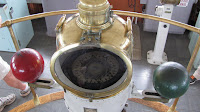
Standing at the wheel, the compass
looks a little like a science fiction device as the massive bronze hood covering the compass is flanked by two colored iron balls. These two devices help aid in re-calibrating the compass, for when you are carrying tons of iron ore the compass is going to have some issues bearing true north. (see right, click to enlarge)

While the handful of passengers would sail in nicely accommodated cabins, all dining happened aft (see right, click to enlarge). That can make for a tricky walk back along the deck, as the railings were minimal and wire. For crew safety, there is a cable running the length of the ship where sailors would tie into. Should the unexpected happen and a person pitched overboard, the safety lines would keep one from truly going over and into the lake.

The engine room (see left, click to enlarge) is a three story area and must have been quite loud. Originally a pure steam-driven engine, it was later converted to an automated boiler system, the first for any lake freighter. She was also among the first lake vessels to incorporate radar. On the deck above the engine room at the stern of the ship is another set of pilot wheels to be used for navigating the snaking rivers that emptied into the lakes.

The Cuyahoga River is one of those snaking rivers and Great Lakes freighters were designed accordingly. There are propeller-driven blowers, two aft and two forward, that face outward at the water line for navigating these tricky turns. (see left, click to enlarge)


Standing at the rear of the Mather looking out into the lake, one can see what at first glance appears to be a ship on the horizon.
But looking closer it is a structure and not a ship. A peek through a mounted telescope, provided for tourists, reveals that this is the intake station for the city of Cleveland's water supply, laying about a mile beyond the shelter of the breakwall. (see right, click to enlarge)

While sailing the Great Lakes isn't as adventurous or appealing as sailing around the world on the open seas, the Great Lakes can be equally dangerous and unforgiving. The legendary wreck of the Edmund Fitzgerald, fabled in song by Gordon Lightfoot, is testament to the perils of the open waters. One of the cargo holds serves as the entry point on the ship and has a gift shop and learning stations as well as a display on the Edmund Fitzgerald (see left, click to enlarge) . But for all the dangers, lake freighters serve as an efficient method of shipping, as one of the displays in the cargo hold show a fully loaded lake freighter can haul the equivalent of 700 rail cars and 2,800 trucks.

- J.