Showing posts with label Toledo. Show all posts

Friday, July 29, 2011

Forgettable War, Unforgettable Fort


Inside Fort Meigs looking at a southwestern blockhouse
Who knew that Ohio boasts the largest historic fort site from the War of 1812?  For that matter, how many even remember there was a War of 1812? Lost among the shuffle of wars taught in the classroom history books, the War of 1812 often comes up short or even missing. But just outside Toledo, Ohio on the inland banks of the Maumee River stands Fort Meigs, an impressive structure that repelled not once, but twice the British invasion of northwestern Ohio.

The War of 1812 isn't as easy to understand as the Revolutionary War or the Civil War,  where causes seemed clear and a war inevitable. President James Madison in many ways was goaded into action from war-mongering politicians, who were tagged with the first use of the term warhawk, over issues involving British practices at sea and out west in the Great Lakes region. Throughout the nation a sizeable number of Madison High Schools today tout the Warhawks as their mascots.

Historic Marker and Visitor Center at Fort Meigs
For Ohio the War of 1812 was about Indians and Canadians, as both were immediate threats to the barely decade-old state. Fort Meigs was built to protect the interior of Ohio from coalition of English and French. The fort stands on the footprint of the original fort and features a nicely sized museum and visitor center. Built in 2003 as part of Ohio's Bicentennial celebrations, the winding displays give a great sense of the timing of the war and the artifacts of the time and those found at the site. A corner of the museum shows how modern science, including thermal imaging was used in renovating the fort.

Costumed interpreter reacting to musket demonstration
A visit on the right day might begin with a tour of the musuem by a costumed interpreter. On this visit the interpreter, a college-aged girl, remarked that in the 19th Century she did not have the right serve her country as a soldier but in the 21st Century does, including re-enacting one.

Fort McHenry in Baltimore certainly gains all the publicity and attention for the War of 1812, having been the site where Francis Scott Key penned the words to the Star Spangled Banner and what would later become the National Anthem.  But Fort Meigs is supersized in comparison to her east coast companion's star shaped designed.  Meigs is spread out over what could encompass two to three city blocks, with sturdy blockhouses every several hundred feet.

One of the eight blockhouse of Fort Meigs
These blockhouses not only served to repel Indian and British forces during the two sieges between May and July of 1813, but later housed pioneer families coming to northwest Ohio while their own homes were built.  Lore has it that one family, late in arriving and unable to secure housing in a blockhouse, set fire to the blockhouse.

Canon portal inside ground floor of a western blockhouse
The walls of these structures are several feet of solid wood with rifle portals that angle inward, giving a small outward target but inside the blockhouse a wide angle to swivel a gun for better accuracy.  A small cannon rests in the middle of the main floor room of each blockhouse with a narrow opening for firing outward.  Today the opening masks the intended view as tall grass obscures a view towards the river.
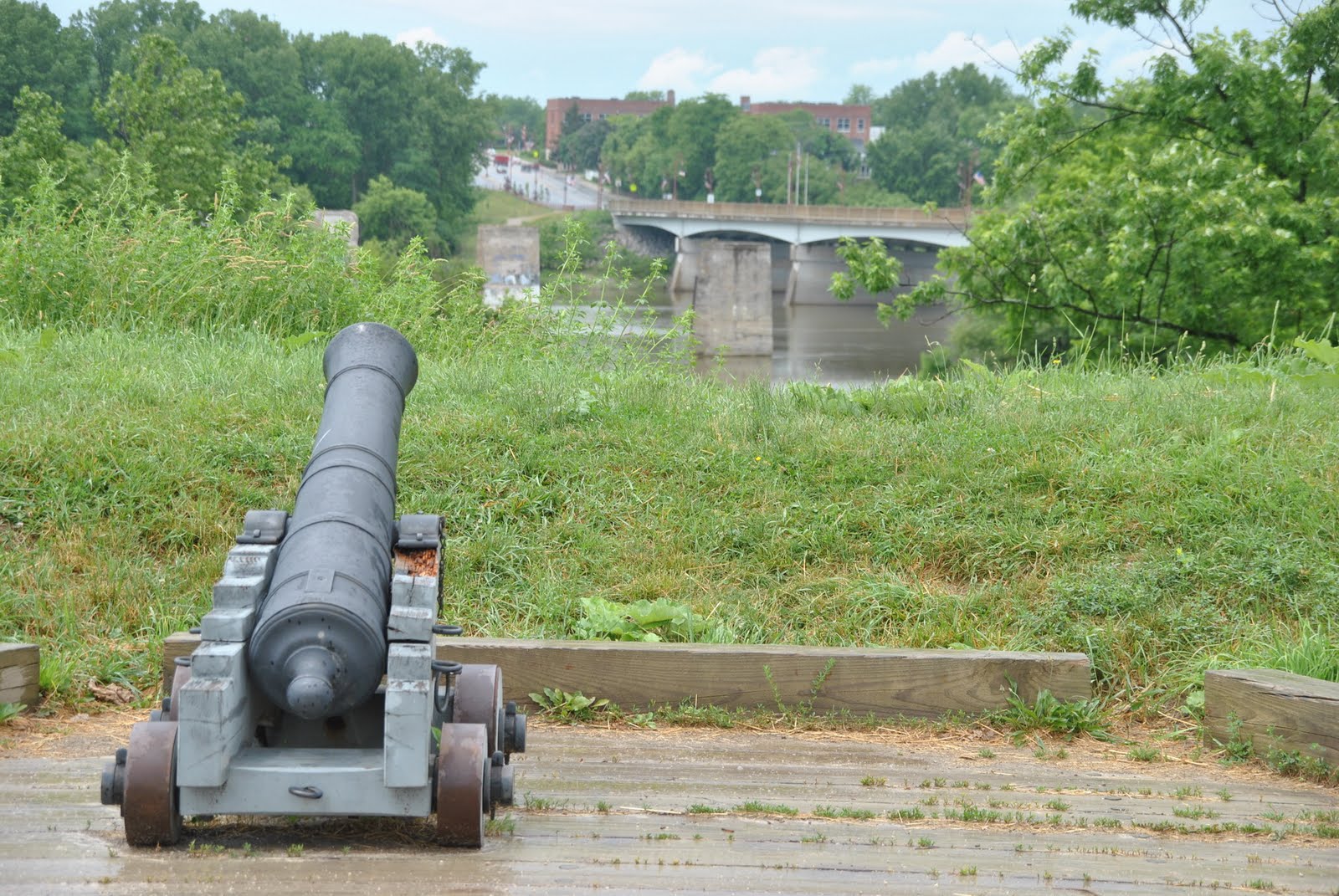
Croghan's Battery overlooking the Maumee and Perrsyburg
Each of the blockhouses today houses a different story about the fort, from soldiers quarters, disease and the role of women, to the science of artillery and a diorama of the fort's early construction. Artillery is a large part of the fort's story, defense and modern re-enactments. Each July 4th costumed interpreters hold a grand series of events, including a cannon fire demonstration on the grounds (click for video).

A series of large mounds were built within the interior of the fort to serve as buffers to artillery attacks from outside the walls and to also for fort storage, including powder magazines.  In 1908 a 100-foot monument to the war and the fort was erected, funded by the Grand Army of the Republic (a Civil War veteran's organization).


WPA Shelter House seen through blockhouse window

After the war and settlement of the area progressed, the fort reverted to farmland.  William Henry Harrison, hero of the war in the region, returned to the location of the fort for a Presidental campaign rally.  During the Great Depression, a road ran right through the former fort and the Works Progress Administration (WPA) built a rest-stop building inside what is today the fort.  The building has been maintained for its historic nature but for a different era.

The fort was reconstructed by the Ohio Historical Society in the 1960s and opened to the public in the 1970s.  A $6 million renovation in 2003 has turned the fort into the largest recreated fort in the nation, something that, just like the War of 1812, tends to get overlooked still today.

Fort Meigs, from the interactive displays, visitor center, museum and carefully reconstructed fort, offers a glimpse into a part of Ohio's history that featured dynamic individuals, such as Tecumseh and Harrison, and, of course, a naval battle on Lake Erie where Oliver Hazard Perry famously noted, "We have met the enemy and they are ours."  

J.


View Larger Map

Monday, April 6, 2009

Play Ball!

The two words that "springs" eternal in Ohioans... "Play Ball!" The hope that maybe this year, after 162 games, their team will be playoff bound. For Cincinnati Reds fans, it's been a long time since the days of the "Big Red Machine" in the 1970s and for Cleveland Indians fans, a long drought lasting to 1948 when the Tribe won it all. Opening day in Ohio can be brutal, as witnessed by game time temperature for today's Red's home opener: 40 degrees. Two years ago the Indians home opening series was shifted to Milwaukee's domed stadium due to 12" of snow.

But Ohio is unique, in that you have a lot of baseball
within the state lines, at every level from division-contending professional teams through just about all levels of the minor leagues and even independent league teams. On any given summer day you can take in a little league game somewhere. (see right, click to enlarge)


You will not lack for a chance to watch a ball game, at some of America's best venues. Only New York, New Jersey, Pennsylvania, North Carolina, Florida and California offer professional baseball parks. From April to October, there's lots of baseball to
take in.

As I grew up in the '70s, Cleveland's Municipal Stadium wasn't much of a stadium by modern means. But it was all I knew. Nestled along the lake and next to Burke Lakefront Airport, some of my fondest sports memories are here. It was a time when you could get up and close... for cheap. Somewhere in my memorabilia is a faded Polaroid picture of a 10-year old (or there about) sitting on the knee of Jack Brohammer, behind the outfield fence on a picture day promotion (see picture left, click to enlarge -note: it may not be Brohammer pictured!). It was set in a cute gigantic baseball-shaped card with the Indians logo on it.

My children will only know Municipal Stadium from the
Western Reserve Historical Society (see left, click to enlarge), which displayed two rows of the seats preserved from the stadium and the gargantuan neon Chief Wahoo that welcomed you to Gate D. (see above right, click to enlarge)


The standing joke was that "today is opening day... and that means the Indians have been mathematically eliminated from the playoffs." So you could buy a ticket in the nose-bleed section of the upper deck general admission and by the 4th inning could be sitting behind the dugout. A popular boredom buster those days was for folks to spell things in block letters using the empty seats of the open sections in the outfield upper decks.

But things changed about 15 years ago as Cleveland built one of the gems of modern sports architecture, in what will always in my mind be, Jacobs Field (now renamed for financial purposes, Progressive Field). Modeled in purpose after the retro-style hit, Camden Yards (still one of the top parks in the world), Jacob's Field opened to a team on the rise. It spawned baseball development around Northeast Ohio.


If you plan your week right, you can today catch the Indians and their farm teams on a tour of top flight facilities around the state. Minor league baseball allows you great seats up close to the action for a much smaller price tag. Sure, most of the players you see will not make it to the major leagues, but some of them will. (see right, click to enlarge)


Start with the short-season Class A Mahoning Valley Scrappers (map, web, ballpark). This is where some of the current draft picks and younger players get their feet wet. It's a small park but offers intimacy and is financially friendly. Your next stop is a just over an hour's drive from the Youngstown area to Willoughby/Eastlake and to the longer-season Class A Lake County Captains (map, web, ballpark). Nestled amongst a busy strip of businesses and retail stores, this can be a bustling and busy park depending upon the game you catch.

Another hour's drive down I-271 to Route 8 will land you in Akron, home of the Double A Akron Aeros (map, web). The gorgeous urban stadium is best attended on a Fireworks Friday night, but get your tickets early as they often sell out the 9,000-some seat stadium. At this level you are sure to see some of tomorrow's big league stars in their youth and inexperience. You can easily leave a game thinking "he's supposed to be a big time prospect?"


New in 2009 is the Indians AAA affiliate, the
Columbus Clippers. Playing for decades on the
west side of Columbus at Cooper Stadium, Clippers recently separated with their parent organization, the New York Yankees and after one short season as the Washington National's highest level farm club, struck a deal with Cleveland. The brand new Huntington Park is another urban gem of a sports stadium, elbow to elbow with downtown stadium brethren Nationwide Arena (home of the NHL Columbus Blue Jackets) and Value City Arena (home to Ohio State University athletics).

Not to be outdone, you can catch other minor league baseball games in Dayton and Toledo.
The Mudhens (ballpark), made famous by proud native Jamie Farr through his character in the TV series M*A*S*H, are the AAA affiliate of the Detroit Tigers. The Dayton Dragons (ballpark) are the Class A Midwestern League farm team of the Cincinnati Reds.

The Reds played in one of the least attractive stadiums during their glory days in th
e 1970s, the cookie cutter circular stadium (once known as Riverfront, then corporate-ized as Cinergy Field) that had clones in Pittsburgh, Philadelphia and St. Louis. But as the retro-trend of ballparks get steaming through the country in the 1990s, Cincinnati upped the ante with one of America's most unique stadiums. Known as the Great American Ballpark, Cincinnati's history with the river and steamboats plays a central theme in the stadium. Giant steamboat smoke stacks grace the viewing lines towards the river and Kentucky beyond.

Each year, thanks to Interleague Play, the Reds and Indians go head to head in a three game series in each city. A five-hour drive can put you in either city and with a stop in between in Columbus and perhaps an extra day or two beyond in each city's suburban sprawl you can find take in a few minor league games as well.

And if you think you still have what it takes to play the game... there are independent leagues and teams in the area. The Lake Erie Crushers are part of the legendary Frontier League and the Chillicothe Paints (ballpark) a part of the Prospect League while cities such Canton (former Thurman Munson stadium) have hosted teams in this league or minor league baseball in the past and have stadiums that are still active and spacious. Even the smaller venues have fan-friendly promotions. Shoot, even the big league parks let your kids run the bases these days! (see right, click to enlarge)

Buy yourself some peanuts and Cracker Jack at a stadium not far from your spot in Ohio!

- J.