Showing posts with label Rutherford Hayes. Show all posts

Sunday, May 13, 2012

How to win without winning: Rutherford B. Hayes

In 2000 the nation saw an unusual occurrence in presidential politics.  At the end of election night the nation did not know who the next president would be as the race came down to who won Florida and would take the majority of Electoral College votes.  Ohio has been here before, with our own Rutherford B. Hayes, who in 1876 did not win on election night either.  Like modern times, Florida in 1876 was part of the undecided vote.
    Hayes came up a quarter of a million votes less than New York’s Samuel Tilden but through political wrangling was given the nod in Electoral votes, becoming the third of eight from the Buckeyevstate to occupy the White House.  Hayes directly followed Ulysses S. Grant and handed the reigns over to James A Garfield, whose brief tenure thanks to an assassin’s bullet ended a streak of 13 straight years of an Ohioan president.

Rutherford B. Hayes gave up a budding law practice in Delaware, Ohio to offer his services to the nation during the Civil War.  Appointed as Major of the 23rd Ohio Volunteer Infantry, Hayes served with distinction and rose to the rank of Major General.  Elected to Congress in 1864, Hayes did not take his seat in Washington until after the war ended.  He went on to become a two-term governor for the state.
    
Hayes moved to Spiegel Grove, the name of the 25-acre estate in Fremont, during 1873 in the midst of his second term as Governor. Upon returning he added a 12,000-book library and a 360-degree wrap around view from a rooftop lantern four stories above the main floor. 

The museum boasts acollection of over 19,000 artifacts and 30,000 images with nearly 2,000 on display within the 52,000 square-foot complex.

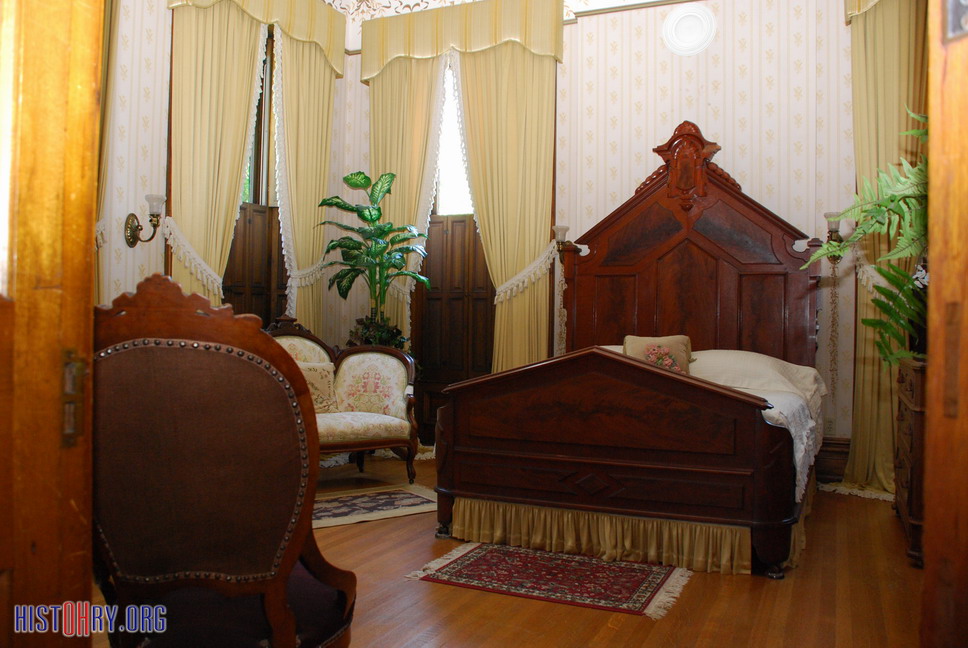
Adjacent to the property is the Dillon House, a Victorian era home that today is part of the Rutherford B. Hayes Presidential Center. 
      
As the Hayes home, the Dillon House can be toured and offers a pristine glimpse into the splendor of the Victorian Era right down to the hinges on the doors. 
      

Charles Dillon gained his wealth in Fremont operating a drug store and chose to display his wealth by moving directly across the street from the former President. Dillon’s wife was daughter of Rutherford’s first law partner, Ralph Buckland.  Buckland also served in the war with distinction and was elected to Congress and also became the Mayor of Fremont.
    
In the 40-year period between 1869 and 1909 five presidents were either born or called Ohio home.  Ohio was the political hub of the nation as the Victorian Age dawned into the 20th Century.  Some criticize Ohio’s claim to eight presidents, as William Henry Harrison was neither born here nor technically resided in the state.  His grandson Benjamin and Ulysses S. Grant did not spend particularly much time Ohio despite being born here.  But similar doubt can be cast on Virginia’s similar claim to eight presidents. 
      
Following Hayes to the White House from Ohio would be Garfield (1881), Harrison (1889), McKinley (1897), Taft (1909) and Harding (1921). Where Virginia was the political powerhouse of the Revolutionary Era, Ohio was as the Victorian Era transitioned toward a world erupting in turmoil.

Spiegel Grove, The Rutherford B.Hayes Presidential Center and the Dillon House are located at the corner of Buckland and Hayes Avenues, south of  U.S. Rt. 20  in Fremont, Ohio.

-J.

Sunday, October 30, 2011

Chasing the Civil War in Ohio

Nestled among ballfields, businesses and major roads is Camp Chase
Ohio had but a few skirmishes during the four years of Civil War between 1861 and 1865, but Ohioans featured prominently in the war.  The third most populated state at the time, Ohio also sent the third most men for the Union Army, but it was leaders such as Grant, Sherman and Sheridan that had a more enduring legacy in the annals of the war.  But Ohio was also home to prisoner of war camps and on the west side of Columbus, nearly invisible to the passing commuter, history lies quietly among ballfields and businesses of the growing capitol of the state.

Established as a training ground along the national road in 1861, Camp Chase served as the temporary home for over 150,000 Union soldiers prepping to fight the Confederates.  Named for former Governor, and then-current Secretary of the Treasury Salmon Chase, the first southern prisoners were higher ranking Confederates who, with an oath of honor, were allowed to wander the City of Columbus. Security soon changed and many of these officers were sent north, to Johnson Island in Lake Erie.

Markers crammed into locations
The reason any remnants of the camp still exist was the 25,000 southerners were passed through the facility as prisoners of war.  As the war drew to an end in 1865, over 9,000 soldiers were still held captive and today over 2,000 gravestones mark those who perished within the walls.

As a prison, Camp Chase was originally situated to hold about 3,500 prisoners but quickly swelled to twice that size.  Upgraded through prison labor to hold 7,000 some believe 10,000 were crammed in the camp by war's end.  At war's end, the Camp quickly was vacated and structures removed.

In 1895 first memorial services were held, started by former Union soldier William Knauss.  A chapter of the Daughters of the Confederacy has sponsored a plaque in his honor along the south wall.  Originally the grave markers had been wooden but at some point around the turn of the century, the official U.S. markers given to all veterans replaced the original markers.

In 1902 a memorial arch was added and remains today, and is the only visible element of the cemetery as motorists and pedestrians pass along Sullivant Ave (the camp's former southern boundary).  Iron gates atop a four foot wall obscure that this is a historic landmark that today is little more in length than a football field in length and breadth.  Atop the monument stands a soldier, symbolically looking south, but with the word "Americans" atop the arch and below the statue.


With little explanation, a confederate cannonball fired at The Battle of Vicksburg and memorial stone stands near the entrance to the cemetery. Donated by a retired member of the Army, no on-site explanation is offered for its presence.  Google searches offer no help as well.

There are those who believe ghosts still haunt the cemetery.  The renowned Lady in Grey is the foremost spirit viewed walking the grounds.  Other mid-Ohio paranormal groups allege ghost activity on the grounds. A descendant of the Lady in Grey disputes these stories.

Ohio historical signage
More poignantly, as Ohio and the country look to commemorate the 150th anniversary of America's deadliest war, the cemetery stands as a reminder of the many forms of suffering that the war brought to a young nation.  Through Camp Chase passed the likes of Ohio's future presidents in Hayes, Garfield, McKinley as well as non-native, but at the time soon-to-be president Andrew Johnson.  The physical structures of the one-time camp may be ghosts to history, but the gravestones of scores of soldiers stands steadfast as today's commuters march on by.

- J.