Sunday, August 9, 2009

Take ride on the WILD side...

Ohio is home to some pretty incredible zoos (Columbus, Cincinnati, Cleveland) but there is one place to go in Ohio where the animals roam free and the visitor is locked up! Roaming across 9,000 acres in southeastern Ohio's Meigs County, The WILDS is a twist on a zoo that shouldn't be missed. It's a place where the wildlife roams freely about the landscape while the visitor safari's around in a bus to view them (see right, click to enlarge).
Billed as the nation's largest animal conservatory, The Wilds opened to public viewing in the mid 1990's, offering a multiple-hour tour around several gated habitats where a handful of animals ranged free. The land in use was reclaimed after AEP had stripped-mine the area for coal and donated to the Wilds. There are rolling, grass covered hills, a few small bands of forest and many small lakes that dot the landscape.

Among the first white settlers to these hilltops were the Lett family, which became a mixed-race family whose descendants held many honored positions in Ohio and included several African-American soldiers in the Civil War serving in colored regiments. An Ohio historical marker notes this near the Overlook cafe and gift shop (see right, click to enlarge), but strangely this bit of historical context does not make any of the guided tour narration.

This is one destination where you have to get off the Interstate to reach, but it is easily found south of I-70 and west of I-77 about 35 minutes southeast of Zanesville and about 20 minutes south (and slightly west) of Cambridge. Mileage and/or Google maps will easily fool you, as your route winds you through some hilly countryside and you will not be able sit on your cruise control once off the highway!

The most common entrance to the Wilds leads along Zion Ridge Road, which as the name implies, is a unlined road that runs along the top of a hill and gives you sweeping views of the area. Once you reach the Wilds parking lot, a shuttle bus takes you from the parking lot to the visitor center. Whether you choose to tour the Wilds or not, parking and shuttle is separate cost of $3.

There are several touring options for the facility, the most common being a multi-hour, air-conditioned, closed shuttle bus (seating about 15) for $20 per adult. Small sliding window panels above the large picture windows allow for smudge, streak and glare free photography. Visitors will view all of the habitat zones while having a chance to visit three different off-the-bus experiences too. You can spend as long or as little as you want at each of these three stops.

A second, and nearly as popular, touring option is an open-air "safari" bus (see left, click to enlarge). This vehicle looks like a school bus that was turned into a rag-top convertible. There are no windows, which allows for great photo opportunities, but a canvas top that protects from the sun. This second, more expensive option at $27 per person, has less flexibility for the visitor to choose how long to visit each step-off site, but you will have the same guide the entire time. Each step-off site will have a narrated visit, whereas the smaller enclosed bus will drop you off for perusing on your own.

These stops are thoughtfully places along the tour as to give a nice variety to the experience. Visitng about 10 years ago, these options did not exist and it was a lengthy afternoon of being cooped up in a bus touring animals.
The first step-off experience is a prairie that edges up to the biggest lake on the property, nestled at the bottom of a pair of ridges (see left, click to enlarge). A few different habitats touch this lake and you can view, although at a considerable distance, different animals. While along the lakes edge, where you can feed the swans and catfish (the only feeding location in the park), we could spy at the waters edge on the opposite shore the Sichuan Takin (pronounced Sesh-wan Talk-in). An unusal breed that looks like a cross between a goat, antelope and... guinea pig. High-powered binoculars, which can be rented at the visitor center, or long-lens photography would be the only way to view these animals at that distance.

The smaller bus option has a guide who drives and talks as you drive through each habitat. The driver will stop along the route at optimum viewing angles for the animals. What makes The Wilds so unique, is that the animals are frequently on the move. It also means you just don't know what to expect (including the driver!). The first habitat we came across the guide sensed our excitement as we spotted a few Rhinoceroses between a grove of trees (see right, click to enlarge) and stopped for several minutes for us to gawk and snap photos even though she couldn't spot them from her seat.

The habitats are set up so that competing animals won't be prowling the pen for prey. Some of the more curious, or perhaps attidue-laden, animals like to come up to the busses. Unlike some animal situations involving visitors, feeding them is not one of them. So the animals are not coming to the vehicles looking for some goodies. The guides are sensitive to the animals and if they plop themselves in front of the vehicle you'll have a few minutes (or more!) wait until the animal decides to scoot along.
The second stop to disembark at was the Mid-sized Carnivore Center. This is the one area that more closely resembles a zoo, as you can walk along a path to a building that overlooks three different pens where hyena, a fox species and cheetahs are penned. Each area is significantly bigger than a typical zoo's displaying area, but they are still constricted in their range. The building also serves as a nice snack stop, offering light-fare (sandwhiches, chips, drinks, ice cream) and ample and modern restroom facilities. The other two step-off sites offer only porta-potties in comparison.

This stop on the day of visiting also was offering face-painting for kids. The fencing around the pens, and throughout the Wilds, is elecrified and it allowed the visitor to get very close to a few snoozing cheetahs. As we moved to catch the next shuttle bus at the Carnivore Center, a cheetah broke out in a gallop as it heard a staff vehicle approaching near its gate and assumed (unfortunately and incorrectly) it was dinner time (see right, click to enlarge).

The final step-off experience is a shorter one, located among the habitat for the white rhino and zebras (see left, click to enlarge). As we entered the habitat you could see the rhino near the enclosure where we would get off the bus, but by the time we were about halfway to the enclosure (about 5 minutes later), they had wandered 200 yards beyond it. Upon arriving (15 minutes after entering the habitat zone) the rhinos had moved another few hundred yards to the edge of the road where we had just been. This enclosure (called The Outpost) gives a sweeping view of the southern end of the Wilds and has several horns and skulls of animals and a brief narration by the guide. Upon leaving the zone, the rhino had moved several hundred yards again, far beyond the road.

Weaving around to the final habitat, you pass a narrow but long lake known as "Lake T". This was an artifical creation left behind from strip mining. The lake was dug by a behemoth of a crane, known as the Big Muskie. Created for strip mining operations, cranes like the Big Muskie were used to dig deep to unearth the coal in the hills (see right, click to enlarge). At a "mere" 27 million pounds, the Big Muskie would dig 185 feet down with each scoop of its 220 cubic yard bucket. The remaining lake was courtesy of Big Muskie, which today resides about 15 miles down Ohio route 83 as a historic/tourist destination in Reinersville, Ohio (map, web, YouTube).
The Wilds has continued to expand options for those interested in visiting. Newly built cabins near the visitor center with a grand view of the region can be rented for overnight or weekend stays. There are several of summer camp options for families and kids that involve the park and the staff. There is even a sunset tour where a catered buffet dinner preceds an open-safari bus tour of the complex.

Due the nature of this twist on nature, visits to The Wilds will offer different experiences each time. As the guide pointed out, each time they drive through a habitat the animals can be doing something different or be in a completely different part of the pen from the previous trip earlier in the day. Sometimes you get an up-close and personal view, as we did with camels and giraffes (see left and right, click to enlarge). But sometimes you might not see them at all, which was the case with the Sichuan Takins stayed along the water line and far from the road
The Wilds offers an experience quite unique to those zoo-goers and an experience unlike many you can find anywhere in the country. But you can see it on a quick jaunt within the Wilds of Ohio.
- J.

Sunday, August 2, 2009

Now departing on track 5... fun!

When is an old train station more than just a train station? The architectural beauty known as Union Terminal (map, wiki) in Cincinnati opened as a grand transportation hub in 1933. In its prime 200+ trains passed daily through the terminal (see right, click to enlarge). Access to the terminal was defined by your transportation method. An outdoor automobile loop dropped you curbside, while three underground loops (each for taxi, motorcoach and streetcar) brought you sheltered into the terminal at various levels. The cavernous lobby led all to the back of the building and to the trains. The building was so significantly grand that is listed as one of the top 50 architectural gems in the nation.

But by the 1960s train traffic reduced to a trickle and by 1972 with only two daily Amtrack trains passing through the station, it was abandoned for a smaller, more manageable downtown location. So what do you do with such a significant architectural treasure? Originally a rail freight company planned to demolish parts of the structure for its freight rail use. The City of Cincinnati thoughtfully moved to put the structure on the National Register of Historic Places (Nation Register link, scroll to "Cincinnati Union Terminal"). In the late 1970s the building was renovated into a family-oriented complex of stores and activities known as "The Land of Oz" but recession ran its course quickly and by the mid 1980s the building was abandoned.

Shortly thereafter the voters of Hamilton County passed a levy to create a museum complex that opened in 1990 as the Cincinnati Museum Center. So how do you turn a train station into a series of museums? With a lot of creativity! Housed today in the complex you will find a Natural History Museum, a Children's Museum, an OmniMax theater, the Cincinnati Museum of History and an accompanying historical library of Cincinnati. Entrance to all three museums is an affordable $12 for adults ($8 for children) and is good all day long.

The main concourse serves as your admissions office, complex gift store and concession area. Just visiting this level to absorb the Art Deco style (see left, click to enlarge) of the terminal is free (almost free, there is a $3 parking charge for the lot). The signage for all parts of the complex are done in the classic Art Deco font and some of the original works appear to have been maintained. A giant U.S. flag drapes from the height of the windows on the facade that easily stretch five stories above the ground (see picture at very bottom).

Carefully restored, there are two massive mosaics that flank the sides of the lobby, both depicting industrial and cultural growth of both the area and the nation (link, scroll to "mosaics"). It is not easy to tell these are mosaics, but the work provides a bright and historic entry-way to the complex (see right and further above, click to enlarge). Bright yellows are painted onto the ceiling works and a marbled floor also lend to the feel of the 1930s.

Each of the wings of the terminal, where passengers arrived or departed by taxi or motorcoach, have been turned into the Cincinnati Museum of History (southern wing) and the Museum of Natural History and Science (northern wing). Each thoughtfully laid out to wind the visitor through what was the entry, or exit, point for many train passengers (see left, click to enlarge). Much of the original structure remains and it is a unique and unusual juxtaposition of various forms history (American, regional, Natural and architectural).

The Museum of Natural History and Science combines many typical elements of the traditional natural history museums. At first blush one can seem underwhelmed at the actual dedication to this aspect of a museum. But more beckons the farther under the terminal you go. Fittingly located in the depths of the complex, they have built what a docent shared was the largest man-made cave in the world (see right, click to enlarge). 500 feet over two levels, the cave has two paths (an easy and an advanced trail) that plunge you into semi-darkness and tight, narrow passageways that simulate the limestone caves found in the southern Ohio, southern Indiana and northern Kentucky region. Included in the cave is an area with bats (behind glass, thankfully!), a two-story stalagmite and plenty of places where you can hide and jump out at those in your party with anxieties about tight spaces and low lighting.

While only briefly in Ohio, John James Audubon was a significant part of the precursor to the Cincinnati Museum of Natural History and Science, having worked as part of the Western Museum Society that was located in Cincinnati around 1819. There is a state marker just outside the wing of the natural history wing and outside the terminal describing his involvement (see right, click to enlarge).

The Duke Energy Children's Museum is rated as one of the top 10 children's museums in the country -- and it is quick to see why it is so well rated. Descending escalators, steps (more advisable for effect than taking the elevator), a two-story tree house complex beckons your children with an adrenaline rush. There are six zones of play & learning (see left, click to enlarge) in the museum: a creative play area that simulates such places as a grocery store or the doctor's office; a construction/building zone with duplos, blocks and such; a screened-off ball-zone with levers, pulleys, chutes and more; a pre-school area romping area (under 4 only!); a massive water-play station and the multi-story tree house complete with tunnels, ladders, slides and even a secret entrance under the turtle tank.

There is also an area for temporary galleries and exhibits. On this particular visit, a dinosaur exhibit was well worth the price of an extra admission cost. Life-size and realistic dinosaurs come (somewhat) alive as children are able to press buttons to hear them roar and move (see right, click to enlarge). Docents also had hands-on artifacts and fossils for all to touch.

In what should serve as a model for other cities, when time and economics make a grand structure obsolete, the community can come together and forge partnerships to create a new public use to reverse the fading glory of history. You will find fewer better examples than excitement that abounds from all ages at Union Terminal!

- J.

Wednesday, July 29, 2009

A Honking Good Time in the Western Reserve

The University Circle area east of Cleveland (map, wiki) is a mecca for culture, featuring numerous museums, the Cleveland Institute of Music, Severance Hall (home to the world renown Cleveland Orchestra) and Case Western Reserve University. Picking the right date on the calendar can land you access to most of the Wade Oval museums for free or special community concert events as part of a community outreach event. The museums on the oval include the Botanical Gardens, Natural History Museum, the Western Reserve Historical Society and the (always free) Cleveland Museum of Art.

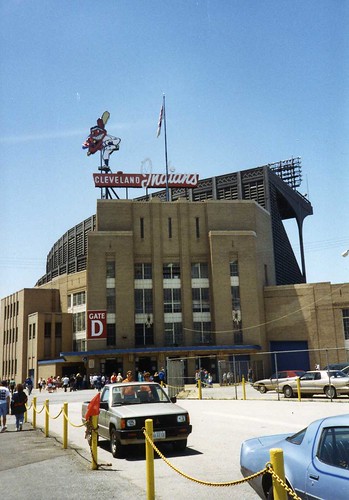
The Western Reserve Historical Society (WRHS) also houses the Crawford Auto-Aviation Museum (see right, click to enlarge) as well as a significant genealogical library. Housed in part of the old Hanna Mansion, the museum is an unusual mix of the old and not-so-old and always features unique temporary exhibits. A personal favorite is the permanent display of the 2-story, neon Chief Wahoo sign from the old Municipal Stadium in Cleveland (see left, click to enlarge). Standing high atop Gate D, it was the entrance point for many children into the world of professional sports downtown during the 1930s through the 1980s (see web picture).

2008 through June 2009 saw an exhibit on women’s and children’s clothing in history (see right, click to enlarge). From colonial times in the Western Reserve (roughly and geographically speaking the Northeast quadrant of Ohio) through the mid-20th Century, this gallery is tucked into a corner of the Bingham-Hanna Mansion section of the museum.

There was also recently a temporary exhibit dedicated to Carl and Louis Stokes. The Stokes brothers were significant early Africa-American pioneers in politics on the large urban level and on the national scene (see left, click to enlarge). Carl was one of the first African-American mayors of a major metropolitan city (Cleveland) and his brother Louis a member of the U.S. House of Representatives. The exhibit showed many unique reproductions of photos and news stories, as well as artifacts significant to African-Americans in Ohio during the tumultuous Civil Rights era.

Wandering through the permanent displays en-route to the temporary galleries in the back portion of the museum winds the visitor through an eclectic mix of history. Archibald Willard’s famous painting from the Revolutionary War, The Spirit of ’76, Colonial picture-letters used to teach reading (creatively forming “WRHS”), a Depression-era carousel horse and other varied historical records from the region (from local African-American newspapers to land grant maps of Bath Township in Summit County) and more grace the wings connecting the main lobby and the temporary exhibits (see right pictures, click to enlarge).

There are more than static displays, as a hands-on “Victory Garden” from World War II beckons younger children and students and invites them to participate with their own gardening at home (see left, click to enlarge).

But the kid in every adult is brought out in the basement, which houses a partial collection of the wide-ranging types of cars that comprise the collection of the Crawford Auto-Aviation Museum (see right, click to enlarge). From early “horseless carriages” to modern sports cars, the mix of wood, steel, chrome and leather beckon. Along one of the walls is a type of “street of dreams” that looks the part of a turn-of-the-century main street.

Depending upon the usage of the other galleries, some of the collection can be viewed on the main level as well. On this particular visit stainless steel was a theme of a segment of a gallery that housed a DeLorean (made famous in the Back to the Future movies from the 1980's) and other unusual vintage cars of stainless steel or brushed nickel finish. Along the same gallery were several planes, including a vintage P-51 Mustang.

Some say that visiting a history museum is a bland walk through historical artifacts; a place to wander and gaze at writings, costumes and furniture. But when a museum such as the Western Reserve Historical Society couples history of sizes, shapes, and perhaps just as importantly, speed there is bound to be a little adrenaline coursing through the body.
-J.

Friday, July 24, 2009

Discover Science in Columbus!

Nestled along the banks of the Scioto River, COSI (for Center of Science and Industry; the acronym is prounounced KOH-SIGH) faces an impressive and young skyline of Columbus, Ohio (see right, click to enlarge). Part of the explosive growth of the area in the 1990s, COSI stands out as one of the premier science and learning "museums" in the state, if not the nation.

Founded several years after a Columbus advertising account executive visited Chicago's Museum of Science and Industry and felt that Columbus should have one too, COSI originated in the old Memorial Hall on Broad Street that had fallen in disrepair. Having visited the original location, COSI was a nice place to take the kids or go on a class field trip, but it did not stand out like it does today.

During the 1990s COSI desired to grow beyond its small footprint and a prime location was along the waterfront right across from downtown. Old Central High School had sat vacant for years and was in danger of being torn down. Many wished to see the building preserved, as it was placed on the National Register of Historic Places in 1985 (click and scroll down). A good portion of the original facade that faces the river was preserved and worked into the design. But the overall design that was constructed is very contemporary (see left, click to enlarge) and little of the internal part of the school remains as it once did.

During the 1990s, Columbus added key tourist destination points in addition to COSI, from a replica of Christopher Columbus's Nina, Pina and Santa Maria, and an expanded and renovated Franklin Park Conservatory (which held an international horticultural convention in 1992), expansion of the Ohio Statehouse (previous blog, statehouse web) museum, and the construction of not one, but two major arenas (one for professional hockey, the other for Ohio State University).

But what made, and still makes, COSI such a selling point is the wonderful interactive and hands on nature of the museum. In every gallery there is much for the visitor to do and for the various ages as well. While the permanent exhibits and an IMAX have their draw, what kept COSI fresh was the temporary exhibits. These short-lived, but interactive, exhibits ranged from the science of sport to dinosaurs that roamed the planet.

In one of the permanent exhibits, King Neptune beckons (see left, click to enlarge) in a watery gallery that allows students to investigate the science of water in one section and see the world beneath the ocean in another (complete with a science submarine that can be climbed into). Robotics are shown off in a tank with a small theater seating situation and kids can step up into a deep-sea diver's suit and look through the helmet.

In another gallery science meets history (see right, click to enlarge), as one enters a street from the 1880s complete with stores and stables. Turning the corner you jump nearly a century to the 1960s, where the little ones can serve up a some fountain fresh shakes and sundaes at the soda shop or sit in the broadcaster's seat at the TV studio and read breaking news to your home audience live on camera.

If it's not a crowded day and time is on your side, you can wait for a seat in the Gadget Cafe (see left, click to enlarge) and get a mini invention lesson led by COSI staff. This gallery adds the word fun to the idea of simple machines. Three different pullies show the advantages to this scientific principal. Laser lights, elecro-magnetics and more beckon in this gallery.

For the very youngest (Kindergarten and younger) there is an entire wing devoted to simple play in conjunction with simple science. Dress up medical stations with X-rays, an ambulance and more beckon the imagination of a child. Spongy balls are seen through half the wing where kids slide and jump on play gear that incorporate the balls with the equipment. And for the youngest of the youngest, there is a raised water pool where toddlers can splash and divert water and even squirt various objects from a sort of high chair with an accompanying yellow rain slicker (see right, click to enlarge).

One of the most popular attractions, which is a separate ticketed activity, is the unicycle on a wire. In what first looks like a circus act on steroids, sitting atop a wire on the 2nd floor of the building is a contraption you can peddle perilously in the open without a net below (see left, click to enlarge). While the rider is strapped into the unicycle (the weighting of the bike doesn't allow it to tip over), nonetheless you pedal out and back with nothing below in an adrenaline laden few minutes. A first-floor assistance is sometimes needed for those who run out of pedal power and need pushed back to the balcony.

COSI has (so far) thankfully survived the downturn that has plagued the non-profit world of museums and the fine arts. There was a time in the early 2000's where many wondered if COSI might shutter its facility. The grandiose vision and size of the complex was too much to sustain. Today a large portion of the original complex is now part of the Ohio State University and includes part of the WOSU broadcasting facilities.

The crush of visitors at the dawn of the millienium may have fallen to lower numbers, but there is no doubt that COSI is still a major draw. Having not visited in nearly 6 or 7 years, a visit this past Spring saw a jam-packed museum with little room to walk through the hallways (which also offer much to see and do -- see right, click to enlarge). I had half expected a trickle of visitors and instead suprisingly had to keep an eye out walking and waited three turns to board the elavator.

Well worth the time, COSI keeps up well with the other major Columbus area attractions.


- J.

Monday, July 13, 2009

The Great (insert ethnicity) Festival of Ohio!

Ohio is home to many different ethnicities in large part due to its geographical placemark in the history of our nation. While early settlers found Ohio a great wilderness, the movement westward during the 1800's saw the state rise to prominence as lake (Erie) and river systems (Ohio) were connected by a series of canals. Railroads later continued the criss-cross of people through our state and with the explosion of industrialization of the 20th century, the coal mines and steel mills (see Youngstown monument right, click to enlarge) brought even more unskilled immigrant laborers into the state.

All of this growth, from building canals, railroads and mining the ores that fueled the steel, and later, automotive industries, Ohio is awash with nationalities from all over the globe. It is a tribute to these "Little Italies" and "German Villages" (see German Village photo left, click to enlarge) that each summer festivals dot the state honoring the different ethnic heritages. You can literally pick a nationality and attend a festival celebration unique to that culture.

Early July brought two competing Italian Festivals to northeast Ohio, one in downtown Akron and the other at the Stark County fairgrounds. Akron's downtown festival was full of the typical vendors of Italian fare, offered live music, inflatables and even the strolling accordian musician (see right, click to enlarge).

Akron's festival was centered at Lock 3 (see left, click to enlarge), located between the historic Civic Theater and the former O'Neil's Department store (wiki history, photo) -- now a parking deck, law offices and two bar's on the Main Street frontage. A former lock along the Ohio and Erie Canal, Lock 3 has been turned into a open air event venue. Winter brings German artisans at the annual ChrisKindl Market along with ice skating on a large outdoor rink. Summer brings a stage and camp-chair seating for many live musical and arts events throughout the summer.

Staged along Main Street were vendors featuring many Italian dishes (see right, click to enlarge). The vendors included the local and regional Italian organizations as well as vendors of all types of food and merchandise. As tempting as it might be, it was hard on this day to partake in typical fair food such as snow cones, dippin' dots or waffle fries when there were cannoli and calzones for the taking.

An impromptu parade flowed through the vendor row on Main Street on the final day of the festival, as two historic 60's era cars (see left, click to enlarge) with the festival court pre-empted the Budweiser Clydesdales (see below right, click to enlarge). It was a neat juxtaposition of two very different, yet very similar, modes of transportation offering heavy horsepower. Despite their youth and beauty, the three festival queens may have been upstaged by the dalmation roaming atop the Budweiser wagon.

A car show was also part of the festival, with a handful of cars from the '50s through modern times, including several eye-popping red Ferrari's. But even the speedy sportsers couldn't match the ambience of a '60 Oldsmobile that personified a different time and place in Ohio with a little car-hop tray sitting atop the window with a meal and a Big Boy doll set atop (see right, click to enlarge).

But pick your ethnicity and you can transpose this festival to many big and little towns through the state throughout the year, as festivals celebrating German, Polish, Irish, Russian, Slavic, Greek and other heritages dot the countryside. The hometown feel of each is unique and part of what makes Ohio unique as well.
J.

Tuesday, July 7, 2009

Bridging a great divide

Today there are many bridges spanning the Ohio River between Ohio and her bordering neighbors. But perhaps the most spectacular of these bridges is one of the oldest, dating to the 1860s, crossing the Ohio at Cincinnati (see left, click to enlarge). Its designer is an American icon who became famous for his creation after this magnificent span between Covington and Cincinnati. John Roebling (bio, bridge wiki) earned his place in history for designing a landmark bridge, the iconic Brooklyn Bridge (bridge history with photos), over the East River in New York City.

The engineering marvel, now-named John A. Roebling Bridge (click for bridge specs), took decades to complete, from concept to design to construction. There was only one bridge crossing the Ohio prior to the "Suspension Bridge" (as
Cincy locals called it then), it was at Wheeling, WV and was designed by bridge-design rival Charles Ellet. Roebling and Ellet had competing designs for the Wheeling project, but Roebling won out in Cincinnati.

One of the chief factors in the snail's pace for the construction of the bridge was economic competition. Ferry boat owners feared loss in revenue from a bridge undercutting their business.
Until the 1960s, there was a toll to cross the bridge. Originally in the 1860s, a horse and buggy would be charged 15 cents. By 1960 though a pedestrian crossing the bridge saw a drop in the surcharge down to 1-cent. According to an historic edition of the Cincinnati Post, a grand total of $13.46 was collected for pedestrian traffic on a September day in 1959.

Political fears also carried weight in the construction delay, as the slave-holding Kentuckians feared a land-bridge to the free-soil Ohio might embolden escape attempts. The historical impact of slavery is still felt in modern time with the Roebling Bridge. The National Underground Railroad Freedom Center, which opened in 2004, poignantly and symbolically was built near the base of the bridge in downtown Cincinnati. Tour guides often begin on the second or third floor of the museum, which offers panoramic and stunning views of the bridge and river, with tales of the bridge and slavery.

Unfortunately some of these guides share mythology of the bridge that isn't true. One guide shared that Ellet had originally been chosen to design the bridge, but was jettisoned after his bridge at Wheeling collapsed. While the Wheeling bridge did collapse during construction from a windstorm, no evidence exists that Ellet was originally chosen to design the span at Cincinnati. Additionally, the guide said the bridge was finished prior to the end of the Civil War, but they refused to open the bridge to traffic until after the war for fear of a mad rush of slaves bolting to freedom. Also false, the bridge's wires weren't even laid until the war had ended. Indeed, the war slowed down the construction efforts.

Regardless of the mythology, the bridge is a testament to the brilliant engineering minds of the time. While the decking was made cheaply, primary due to lack of materials in a war-torn economy, and rebuilt at the dawn of the 20th Century, the stone pillars were constructed to carry weights beyond anything imagineable in the day (see right, click to enlarge). The bridge has withstood many floods, small and large, and remained the only bridge spanning the Ohio River to remain open during the great 1937 flood (photo link). Even recent flooding in the late 1990s (photo link) never crested nor damaged the bridge.

But with progress poverty cannot be escaped. Hidden to the rush of cars speeding along the bridge is an encampment along the Ohio side of the river that can only be seen walking the bridge. About a dozen little makeshift tents, of cardboard, wood or Pick-up truck tarps, can be seen in a little homeless camp (see left, click to enlarge). Invisible to both the occupants of hi-rise office towers and the sight-seeing public on riverboat cruises, life goes on for those who have no place to call their own. An attempt by police to sweep the riverfront in the name of public safety was recently thwarted as an attack against homeless.

Today one can walk the bridge between Covington and Cincinnati, crossing between the two business districts in less time than watching a rerun of an episode of WKRP in Cincinnati (view pilot episode), which incidently did show a glimpse of the bridge in its opening credits. There is ample space at each of the two massive stone pillars to gawk (see left, click to enlarge) at the ability to build such a marvel at a time when steam powered machines were in their formative years.

Today both Covington and Cincinnati's skylines continue to grow outward and upward. New professional sports venues skirt the river and more new construction is evident near the bridge base in Cincinnati. I'm sure Roebling would not be surprised to see his structure still standing and that Cincinnati would be a major city in America (at the time it was being built it was among the nation's top 10 in population). But he might be pleasantly surprised at the other architectural structures around the Queen City and across his bridge into Kentucky. But will they still impress 145 years in the future?

- J.

Saturday, July 4, 2009

Independence in Ohio, as America


Ohio holds a special place in the nation. Over time it was the wild west, the cradle of presidents and once known as (and still on some license plates) the heart of it all. The Fourth of July is special all across America and Ohio holds no special Independence Day significance. Celebrations here aren't bigger, better or brighter than elsewhere. We have our backyard fireworks and sparklers (see neat photo trick below right) at our cookouts and our parades, festivals and rib events too.


But it has been said that Ohio is a bellweather state for the nation. Our demographic slice of the American Pie is that of the typical American. Many franchises sample their wares in Ohio before they trot them out nationwide, testing them on us first.

I've had the great privilege of knowing many from around the nation and learning of the linguistic idiosyncrasies of the different regions. Most Ohioans will say we don't have an accent, or "twang" of any type (sans the Appalachia region, where one might "warsh" the glass after drinking the A&W "ruht" beer from it). For whatever reason, we talk like they do on TV. The spoken American on TV sounds like the people came from Dayton, Elyria or Steubenville. In the mid 1800s Ohio was a budding and promising economic giant. Canals and railroads brought the west to the east. Towns like Cincinnati grew mightily and at one point was the biggest city west of the Appalachian Mountains. Ohio sent more soldiers off to the Civil War than all but two other states. Postwar America saw seven presidents from Ohio until Harding died in office in 1923.

The ups and downs of America are often seen through Ohio's windows. The industrial might of a nation emerging from the shadows of World War II were in large part due to the steel, rubber and aviation industries of Ohio. Perhaps nowhere else can the suburbanization of the baby boomer generation be seen like it is ringing the cities of Cleveland, Columbus and Cincinnati. And when the current economic downturn became a national dilemma, those in Ohio had seen the housing market stumble well in advance.

So as we celebrate a nation born at the hands of revolutionary minds, Ohio has played a major role in the shaping and shifting of a nation's booms and busts. Happy anniversary America, through the eyes of Ohio.

- J.