Sunday, January 15, 2012

Garfield's Short Term and Long Term Memory

Ohio's history with presidents is unique in many ways.  We claim, along with Virginia, eight presidents as our own.  Few doubt Virginia's importance in the early years of our nation, but many wonder why so many from Ohio?  James A. Garfield's grand memorial at the historic Lakeview Cemetery in Cleveland presents an excellent case study as for the long and the short of Ohio's place in American presidential history.

Garfield, like fellow Buckeye Presidents Grant, Hayes, Harrison and McKinley, served in the Civil War with notable distinction. Ohio being a growing state in Victorian America, with Cincinnati being the largest city west of the original 13 states, her influence on the political scene rivals what large populous states of New York, Texas and California are today.  War service, along with Ohio's national prominence, is why seven of the twelve presidential terms served between 1869 and 1923 had an Ohioan in the White House.


James A. Garfield served but 200 days but you would think he served two full terms by his legacy at Lakeview Cemetery.  Like his executive colleague's resting place an hour south, Garfield's memorial rises high into the sky, easily dwarfing William McKinley's structure in Canton.  However, both offer sweeping views of their adopted cities seen through considerable climbing of steps.  McKinley's steps lead toward his lofty memorial, while Garfield's wind through the inner structure and lead to an impressive exterior balcony.

Walking around the structure, the native Ohio sandstone shows the weathering of time against Lake Erie's wind, rain and snow.  Construction surprisingly began a mere four years after Garfield's assassination, was completed by 1889, was added to the National Register of Historic Places in 1973 and received a half-million dollar grant for renovations in 1985.  Time has blackened the three tier, 180-foot structure and exterior sculptures, but fits in appropriately with the surrounding cemetery grounds.


The five bas relief sculptures along the exterior walls depict Garfield's life as a teacher, soldier, legislator and president.  Many of these elements can be seen in the murals inside the memorial as well.  Stained windows are numerous, easily seen from both outside and inside.  The entrance to the memorial offers grand murals painted on the walls, intertwining nicely with stained glass windows throughout the structure.

Winding staircases lead to the crypt below, the observation balcony above and the upper level where you can gaze down upon the statue of Garfield in the inner room.  Every inch of the memorial appears to have paint, tile, marble or other decorative aspects.  I found it strange that one of these large murals depicts the assassination being carried out.

The stairs leading up narrow and twist as you climb to the observation level.  But the reward is worth the effort, as the large terrace gives a sweeping view of the lake and downtown Cleveland.  It would be intriguing to see photographs taken of the skyline over the last 100+ years from this spot.  Lakeview at first seems a deceiving name for the cemetery, as the entrance and grounds are over a mile inland from Erie's shores.  But Garfield's memorial at one point easily would have looked out over the lake before development altered site lines.


The crypt in the basement contains the caskets of Garfield and his wife, plus the ashes of his daughter and husband.  There are those who believe the ghost of Garfield haunts the crypt, reporting strange lights from the basement.  Allegedly Garfield haunts his former home, Lawnfield, in Hiram as well as the House of Representatives in Washington. 

If one were not knowledgeable about American History and our presidents, it could easily be thought that Garfield was one of the nation's strongest leaders by the sheer magnitude of his memorial.  McKinley's, by comparison, is not nearly as grand but he does have a sprawling museum and presidential library.  Perhaps Garfield could have been one of our top 10 president's, but his fate was intertwined with that of many Ohioan's that occupied the Executive Mansion.  Of Ohio's eight claimed presidents, half did not complete their term as president due to death in office.  Garfield was the first assassinated, as will be McKinley just short of 20 years later, with William Henry Harrison and Warren Harding dying in office from illness.  Like Harrison, Garfield did not manage to complete a full year.

Perhaps the magnitude of the structure is necessary, as Lakeview is a sprawling cemetery with little help in finding the grave sites of Cleveland's movers and shakers.  A little help on Google map is useful to scout the location before a visit.  But for someone who so briefly occupied the memory of the people as President, his memorial will continue to surprise those who did not realize this grand structure existed nor has stood for a century.

- J .


View Larger Map

Sunday, January 8, 2012

Central Ohio's Cave of Wonders

Historic signage near the entrance
In 1897 a teenage farm hand working the land came across a large sink-hole and curiosity has led to a century of Eco-Tourism in the countryside about an hour west of Columbus.  Robert Noffsinger poked around that sinkhole and found a series of caves below and told the farm's owner, William Reams, who immediately saw an economic opportunity.


Over the intervening century-plus, countless visitors have descended and wandered the estimated 2 miles of passageways. A visit is always cool -- in a multitude of ways -- as the year-round temperature is 54 degrees with over 90% humidity.  The air is cleaner than that above the ground, as the water in and around the caves serves to filter it.  While a trip to the caves is possible regardless of the surface weather, keep in mind that accessing the site through the rolling hills and 2-lane roads may be tricky in icy and snowy weather.

There are two tours of the caves, a regular tour and a historic tour, led by a guide in front and in behind.  Part of this dual touring is to keep groups together while another to keep visitors from plundering the cave as the first tourists did in the early 1900's.  First visitors would take home their own stalactite from the cave, as the tour was a simple light and rope and wave to where the entrance was without the assistance of any guides.


The stalactites and stalagmites in the cave of our two types, calcite and iron oxide (yes, rust).  There a places where both exist together and combinations of the two are seen.  The tour is well lit and photography is encouraged.  But watch your step, as puddles off the main pathway make trying to get the perfectly framed shot challenging.

One room, a half-acre in size, offers a panoramic view of formations that is simply stunning.  The alleged largest stalactite in Ohio resides here as well, and is an estimated 400 pounds.  These formations take 500 to 1,000 years to form and, understandably, a strict no-touching policy is in place as even a single finger touch can cause irreparable damage to nature's slow-drip action.

The toughest part of the 45-minute, mile-long tour is the ascent at the conclusion of the experience.  A 60-step concrete stair way leads you back to the surface, and its current weather conditions.  On a hot day the surface conditions strike you quickly.

There are ample facilities at the caverns, as a welcome center has a sizable gift shop and for the warmer months sells bags of dirt with rocks inside that allow for some panning in the outside miniature mill run.

While at first blush it may seem that a visit to the Caverns is all there is to do in the area, driving towards West Liberty reveals more history to discover.  Along, and just off, Ohio Route 287 is a pair of "castles" built by the Piatt Family in the 1860s.  Both striking structures are available for tours and make for a great half-day in Logan County.

The history of Ohio may have been written by humans, but sometimes those humans took advantage of the natural resources around them.  And Ohio has its share of geologic delights that have shaped the history of Buckeye's.

- J.


View Larger Map

Saturday, December 31, 2011

Still milling about after all these years...

Clifton Mill complex
The rushing waters of the Little Miami River between Columbus and Dayton once created economic opportunity for dozens of mills in the 1880s.  Today a single mill provides seasonal delight to thousands while maintaining the legacy of enterprise in Ohio.  Greene County was home to over 70 mills in the early 1800s, as entrepreneurs took advantage of the river's natural energy source.  Over 16 were located in the Clifton area, of which today only the Clifton Mill remains.

Clifton Mill gorge
The Clifton Mill is the only mill that remains in operation. Originally constructed in 1803 as a complex of mill, tavern, trading post and distillery, the mill has a long history of community service.  During the War of 1812, the mill's grain was provided for soldiers and between 1908 and 1938 it provided electricity for the villages of Clifton, Cedarville and Yellow Springs.

covered foot-bridge at Clifton Mill

A covered foot-bridge allows the visitor a chance to walk over the river as it bounds down and through the gorge that powers the mill. The bridge gives a great photo opportunity of the mill proper and the gorge racing downriver towards the Ohio River miles away.  While the structures today are restored, the bridge itself has a weathered look to its that adds authenticity to the history of the mill.
Clifton Mill water wheel

Another nearby mill, the Grinnell Mill, dates back to 1821, built on the foundation of the previous mill that burned down.  It had been functioning since 1814.  The mill deteriorated over time, as the Grinnell family (owned between 1864 and 1948) handed it over to nearby Antioch College, who then had no resources to restore the mill when it was declared a fire hazard in 2003.  It has been lovingly restored and operates as a Bed and Breakfast with tours of the mill.

lights awaiting the holiday lighting season
Progress didn't benefit Clifton.  As floods wiped out mills along the river, electric power was preferred over water power and businessmen rebuilt elsewhere. The decision to locate the railroad at nearby Yellow Springs further eroded business in the village and in 1849 an outbreak of Cholera led to half the population's demise and many others simply chose to leave town.

Today the 200-person village of Clifton is easy to miss as you motor along Ohio SR 72 heading south from Springfield.  Tucked away on the west side of Rt 72 about 15 minutes south of Springfield, it is easy to miss Clifton 11 months out of the year.  But it's December that Clifton becomes a not-to-miss destination for Ohioans.  During the holiday season, 3.5 million lights are used to turn the gorge, mill and surrounding property into a winter wonderland.  

A miniature animated village and a 3,500-piece Santa collection compliment the lightscapes around the mill, which includes both a restaurant and gift shop.  A crew of six take most of three months to set up the displays that are viewed by thousands.  It has been an annual event for over 20 years.

The other 11 months find a much slower pace around the mill area. The mill claims to be the largest water-powered mill still in operation and conducts daily tours.  There are other buildings in town of historic nature, some available to tour others just showpieces.  

Clifton village other properties
While Clifton's hey-day has long since passed, and area residents commute to jobs around the area between Dayton, Springfield and Columbus, a little piece of what was a major industry in Ohio continues to flow just as the river it utilizes for its life.

- J.

Sunday, October 30, 2011

Chasing the Civil War in Ohio

Nestled among ballfields, businesses and major roads is Camp Chase
Ohio had but a few skirmishes during the four years of Civil War between 1861 and 1865, but Ohioans featured prominently in the war.  The third most populated state at the time, Ohio also sent the third most men for the Union Army, but it was leaders such as Grant, Sherman and Sheridan that had a more enduring legacy in the annals of the war.  But Ohio was also home to prisoner of war camps and on the west side of Columbus, nearly invisible to the passing commuter, history lies quietly among ballfields and businesses of the growing capitol of the state.

Established as a training ground along the national road in 1861, Camp Chase served as the temporary home for over 150,000 Union soldiers prepping to fight the Confederates.  Named for former Governor, and then-current Secretary of the Treasury Salmon Chase, the first southern prisoners were higher ranking Confederates who, with an oath of honor, were allowed to wander the City of Columbus. Security soon changed and many of these officers were sent north, to Johnson Island in Lake Erie.

Markers crammed into locations
The reason any remnants of the camp still exist was the 25,000 southerners were passed through the facility as prisoners of war.  As the war drew to an end in 1865, over 9,000 soldiers were still held captive and today over 2,000 gravestones mark those who perished within the walls.

As a prison, Camp Chase was originally situated to hold about 3,500 prisoners but quickly swelled to twice that size.  Upgraded through prison labor to hold 7,000 some believe 10,000 were crammed in the camp by war's end.  At war's end, the Camp quickly was vacated and structures removed.

In 1895 first memorial services were held, started by former Union soldier William Knauss.  A chapter of the Daughters of the Confederacy has sponsored a plaque in his honor along the south wall.  Originally the grave markers had been wooden but at some point around the turn of the century, the official U.S. markers given to all veterans replaced the original markers.

In 1902 a memorial arch was added and remains today, and is the only visible element of the cemetery as motorists and pedestrians pass along Sullivant Ave (the camp's former southern boundary).  Iron gates atop a four foot wall obscure that this is a historic landmark that today is little more in length than a football field in length and breadth.  Atop the monument stands a soldier, symbolically looking south, but with the word "Americans" atop the arch and below the statue.


With little explanation, a confederate cannonball fired at The Battle of Vicksburg and memorial stone stands near the entrance to the cemetery. Donated by a retired member of the Army, no on-site explanation is offered for its presence.  Google searches offer no help as well.

There are those who believe ghosts still haunt the cemetery.  The renowned Lady in Grey is the foremost spirit viewed walking the grounds.  Other mid-Ohio paranormal groups allege ghost activity on the grounds. A descendant of the Lady in Grey disputes these stories.

Ohio historical signage
More poignantly, as Ohio and the country look to commemorate the 150th anniversary of America's deadliest war, the cemetery stands as a reminder of the many forms of suffering that the war brought to a young nation.  Through Camp Chase passed the likes of Ohio's future presidents in Hayes, Garfield, McKinley as well as non-native, but at the time soon-to-be president Andrew Johnson.  The physical structures of the one-time camp may be ghosts to history, but the gravestones of scores of soldiers stands steadfast as today's commuters march on by.

- J.

Wednesday, August 3, 2011

Castles among the Corn

The front of Mac-o-Chee Castle
Among the sprawling fields of soybeans, among what was corn and wheat, stand a pair of castles that conspicuously stick out as you travel State Route 287 through Union County just northwest of Columbus.  What was once the lands of the Shawnee Indians, a pair of brothers built on a grand scale just a mile apart from each other in the post Civil War years in Ohio.  The Piatt Castles, called Mac-o-Chee and Mac-a-Cheek Castles, are off the beaten path but an interesting bit of Ohio History and why the state has and still is a destination location.

Library of Mac-o-Chee
The Piatt family was involved in early Ohio politics and trading along the Ohio River.  Benjamin Piatt served as a judge in Cincinnati but later moved the family to Logan County where Donn Piatt was raised.  Donn was educated in Cincinnati and moved on to Washington, DC, where he became heavily involved in political causes as a lawyer and newspaper columnist.  An ardent abolitionist, Piatt served in the Civil War as chief off staff to General Schenck in Maryland.  At a moment when Schenk was temporarily away from his post, Piatt is said to have issued an order to enlist only negro slaves in Maryland into the army which would have served to emancipate all of them.  Lincoln is said to have berated Piatt and forced his resignation from the army.  In the years following the Civil War he was quite an inflammatory character towards Presidents Grant and Hayes.


Piatt had the castle Mac-o-Chee built with state of the art technology of the time. Screened windows were patented in the early 1880s and Mac-o-Chee not only uses window screens but unique half-round transom screens above the doorways.  Indoor plumbing was not common at the time, but the home has unique first flushing commodes.

The home fell out of the Piatt family in the 1900's and was used,  unbelievably, as a barn for a local farmer who purchased the property for the land and not the house.  The fanstastic wooden floors have been carefully refurbished but still bear a place where the tractor stored in the "barn" irreparably stained the floor.

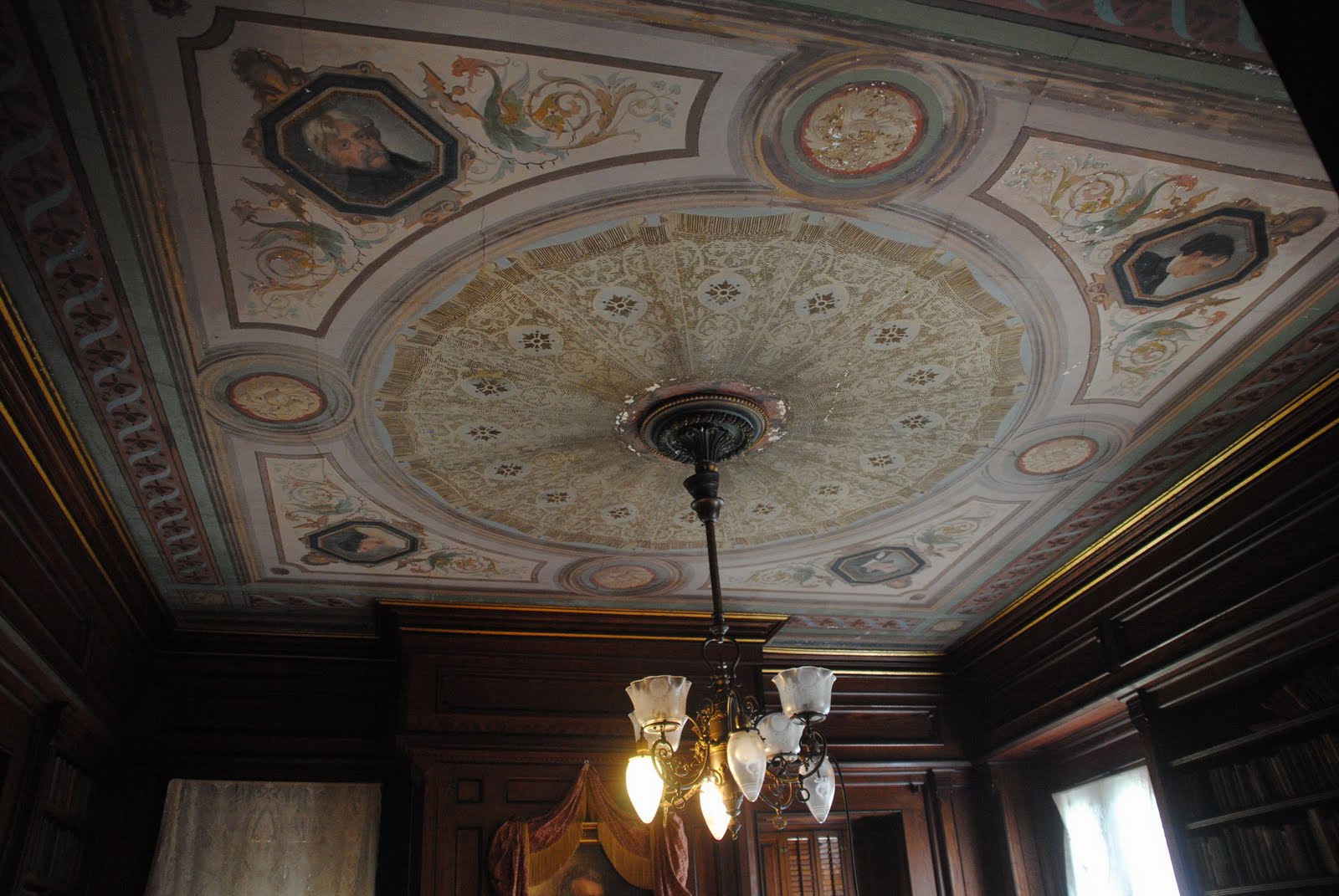
As eccentric as the home appears from the road, it was fitting that the home was saved by another eccentric individual.  An unwed daughter of Asa Griggs Candler, the founder of Coca Cola, was traveling through Union County in the 1950s and stopped at the castle and ended up purchasing the house.  One room today bears some of the furniture that she purchased to stock the home, as a castle home should have furniture you would find in a castle.

Mac-o-Chee today shows the wear and tear of a 100+ year old home.  The original paints on the walls and ceilings are fading and chipping.  While a historic home, funding doesn't appear available to speedily restore the home to its one-time splendor.  The tour of the home is mostly self-guided after a staff member gives a basic history and context introduction for the visit.

Abraham Piatt's Mac-a-Cheek
No more than two minutes down the road is the sister castle, Mac-a-Cheek.  Both castle names are derived from the Shawnee language that means "smiling valley."  Donn's brother Abraham built Mac-a-Cheek a bit farther from the road, but this did not stop visitors in the early 1900's from wandering the grounds and then asking to tour the castle.  Abraham thought that if he began charging for tours, which at the time consisted only of the front room of the house, that it would deter tourists.  The opposite occurred.

While the home incredibly stayed in the family for 6 generations, tours continued and it is believed to be the oldest home in Ohio with continuous running tours.  As time marched on, the family receded to other areas of the house and opened up more of the house for tours.  The most impressive room in the house is the grand parlor, which is the size of two or three regular sized rooms and like the sister castle Mac-o-Chee also has painted ceilings and intricate wood working on the floors and walls.
Today one or both homes can be toured.  Mac-a-Cheek in 2011 has a set up an impressive display of Civil War artifacts on the second floor of the home as a commemoration of the 150th anniversary of the Civil War.  A local resident created a diorama of a Virginia battle where an ancestor perished.  The amount of Civil War relics rivals or surpasses that of many larger museums while being restricted to two adjoining rooms. 
Mac-a-Cheek doesn't have tour access to the third floor or towers, while Mac-o-Chee does.  There are allegedly stories of ghosts at Mac-o-Chee.  There are also You Tube videos of the houses in modern times and a 1950s home movie that shows Mac-o-Chee.

Two castles amidst what used to be field of corn, still standing today as a symbol that Ohio once was home to those with powerful national ambitions but wanting to call home a place in the heartland.

J.


View Larger Map

Friday, July 29, 2011

Forgettable War, Unforgettable Fort


Inside Fort Meigs looking at a southwestern blockhouse
Who knew that Ohio boasts the largest historic fort site from the War of 1812?  For that matter, how many even remember there was a War of 1812? Lost among the shuffle of wars taught in the classroom history books, the War of 1812 often comes up short or even missing. But just outside Toledo, Ohio on the inland banks of the Maumee River stands Fort Meigs, an impressive structure that repelled not once, but twice the British invasion of northwestern Ohio.
The War of 1812 isn't as easy to understand as the Revolutionary War or the Civil War,  where causes seemed clear and a war inevitable. President James Madison in many ways was goaded into action from war-mongering politicians, who were tagged with the first use of the term warhawk, over issues involving British practices at sea and out west in the Great Lakes region. Throughout the nation a sizeable number of Madison High Schools today tout the Warhawks as their mascots.

Historic Marker and Visitor Center at Fort Meigs
For Ohio the War of 1812 was about Indians and Canadians, as both were immediate threats to the barely decade-old state. Fort Meigs was built to protect the interior of Ohio from coalition of English and French. The fort stands on the footprint of the original fort and features a nicely sized museum and visitor center. Built in 2003 as part of Ohio's Bicentennial celebrations, the winding displays give a great sense of the timing of the war and the artifacts of the time and those found at the site. A corner of the museum shows how modern science, including thermal imaging was used in renovating the fort.

Costumed interpreter reacting to musket demonstration
A visit on the right day might begin with a tour of the musuem by a costumed interpreter. On this visit the interpreter, a college-aged girl, remarked that in the 19th Century she did not have the right serve her country as a soldier but in the 21st Century does, including re-enacting one.

Fort McHenry in Baltimore certainly gains all the publicity and attention for the War of 1812, having been the site where Francis Scott Key penned the words to the Star Spangled Banner and what would later become the National Anthem.  But Fort Meigs is supersized in comparison to her east coast companion's star shaped designed.  Meigs is spread out over what could encompass two to three city blocks, with sturdy blockhouses every several hundred feet.

One of the eight blockhouse of Fort Meigs
These blockhouses not only served to repel Indian and British forces during the two sieges between May and July of 1813, but later housed pioneer families coming to northwest Ohio while their own homes were built.  Lore has it that one family, late in arriving and unable to secure housing in a blockhouse, set fire to the blockhouse.

Canon portal inside ground floor of a western blockhouse
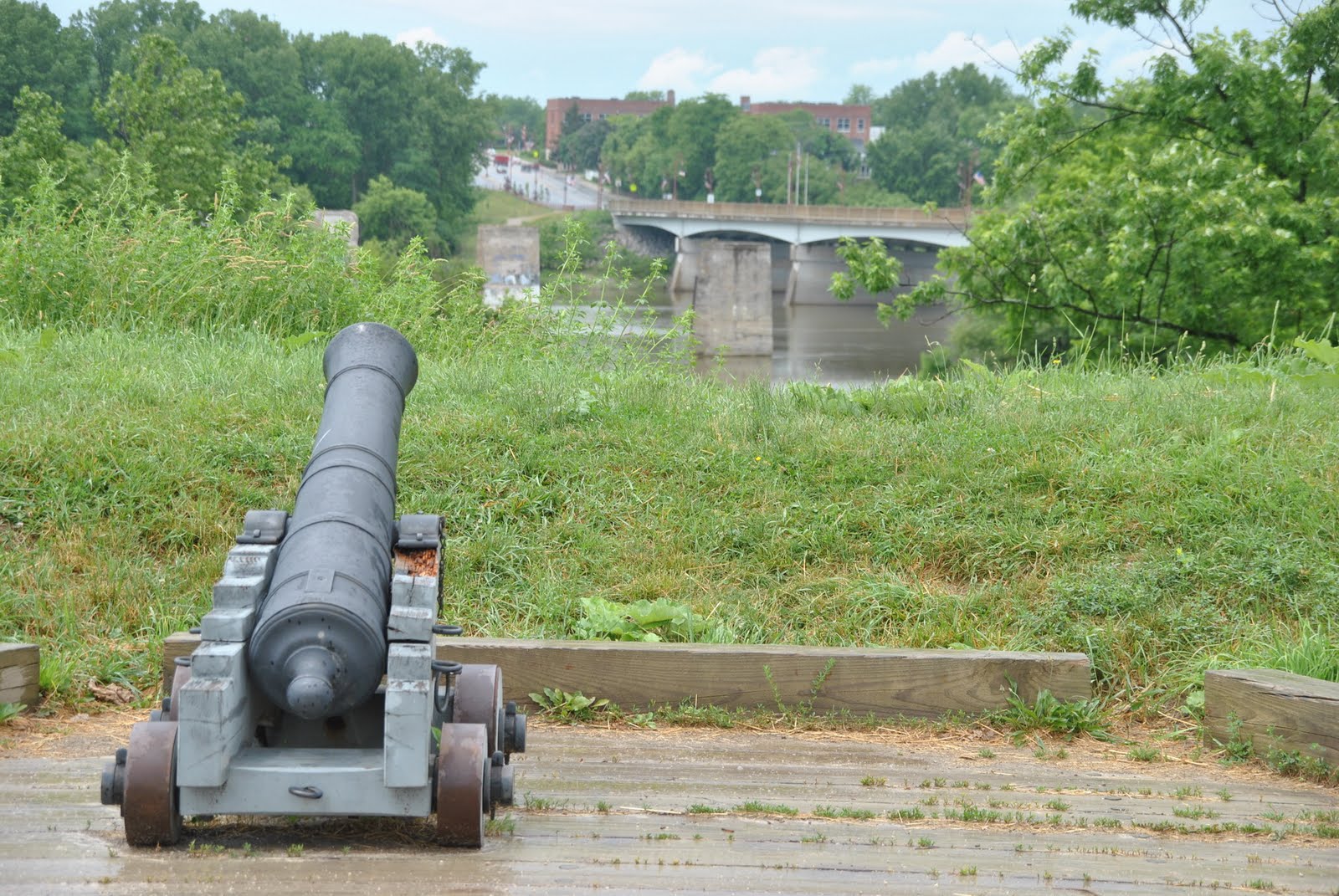
The walls of these structures are several feet of solid wood with rifle portals that angle inward, giving a small outward target but inside the blockhouse a wide angle to swivel a gun for better accuracy.  A small cannon rests in the middle of the main floor room of each blockhouse with a narrow opening for firing outward.  Today the opening masks the intended view as tall grass obscures a view towards the river.

Croghan's Battery overlooking the Maumee and Perrsyburg
Each of the blockhouses today houses a different story about the fort, from soldiers quarters, disease and the role of women, to the science of artillery and a diorama of the fort's early construction. Artillery is a large part of the fort's story, defense and modern re-enactments. Each July 4th costumed interpreters hold a grand series of events, including a cannon fire demonstration on the grounds (click for video).

A series of large mounds were built within the interior of the fort to serve as buffers to artillery attacks from outside the walls and to also for fort storage, including powder magazines.  In 1908 a 100-foot monument to the war and the fort was erected, funded by the Grand Army of the Republic (a Civil War veteran's organization).


WPA Shelter House seen through blockhouse window

After the war and settlement of the area progressed, the fort reverted to farmland.  William Henry Harrison, hero of the war in the region, returned to the location of the fort for a Presidental campaign rally.  During the Great Depression, a road ran right through the former fort and the Works Progress Administration (WPA) built a rest-stop building inside what is today the fort.  The building has been maintained for its historic nature but for a different era.

The fort was reconstructed by the Ohio Historical Society in the 1960s and opened to the public in the 1970s.  A $6 million renovation in 2003 has turned the fort into the largest recreated fort in the nation, something that, just like the War of 1812, tends to get overlooked still today.

Fort Meigs, from the interactive displays, visitor center, museum and carefully reconstructed fort, offers a glimpse into a part of Ohio's history that featured dynamic individuals, such as Tecumseh and Harrison, and, of course, a naval battle on Lake Erie where Oliver Hazard Perry famously noted, "We have met the enemy and they are ours."  

J.


View Larger Map